Business Cards 10.16.26
Duplex and Triplex Business Cards: What They Are and Why Designers Love Them

Daniel Cantor
A business card can do much more than share a name, phone number, and website. Its paper, thickness, texture, and finishing details can communicate a brand’s personality before a conversation even begins. For designers looking to move beyond conventional paper stocks, duplex and triplex business cards offer an opportunity to combine multiple layers of paper into a distinctive, tactile design. These constructions can create contrasting colors, different textures on each side, and a substantial feel that helps a card stand out in a competitive professional environment.
Whether you are developing stationery for a luxury brand, a creative studio, a boutique business, or a corporate client, understanding layered printing opens up new possibilities for premium branding. If you are exploring business card design nyc, the right combination of materials and printing techniques can help you create a memorable first impression. Contact Japan Printing to request a quote for your business card design and printing project, and discover how thoughtful material choices can bring your brand identity to life.
What Are Duplex and Triplex Business Cards?
Duplex and triplex business cards are produced by bonding multiple sheets of paper or cardstock together to form a single, thicker card. Unlike conventional business cards made from one sheet of cardstock, these constructions allow designers to combine different materials, colors, and surface characteristics within the same piece. The result is a card whose construction becomes part of its visual identity.
Duplex business cards consist of two bonded layers. The two sheets can use the same paper for a consistent appearance or different stocks to create contrast between the front and back. For example, a designer might combine a smooth white surface with a textured or colored reverse to give each side a distinct personality.
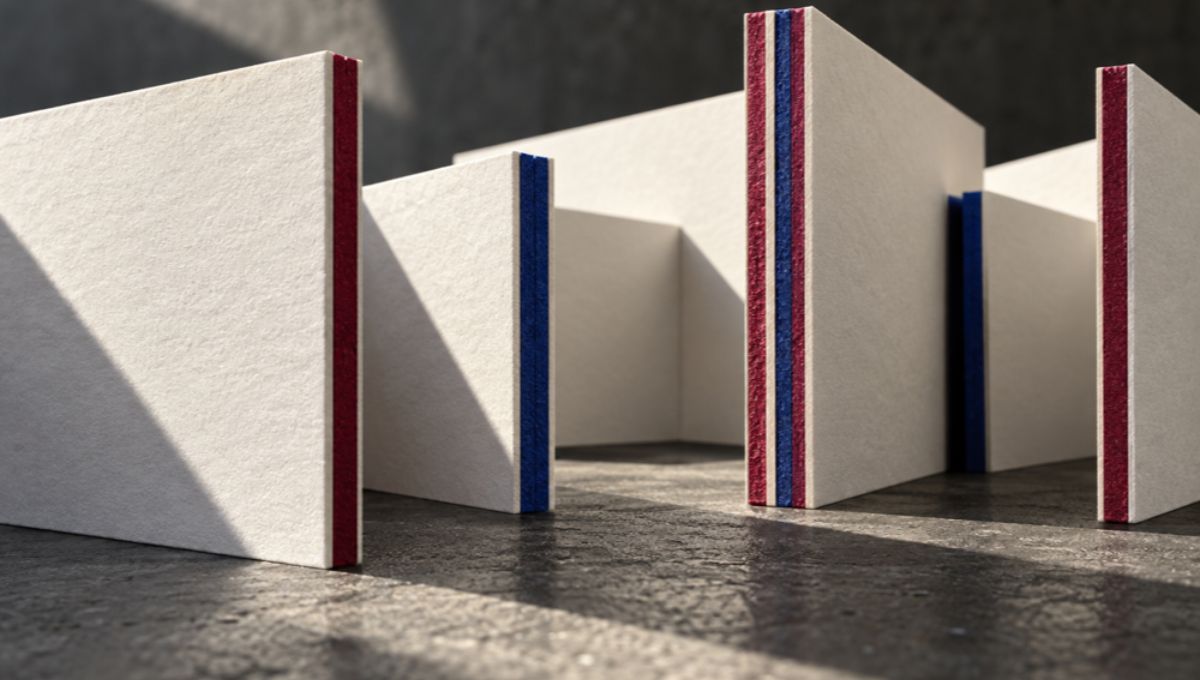
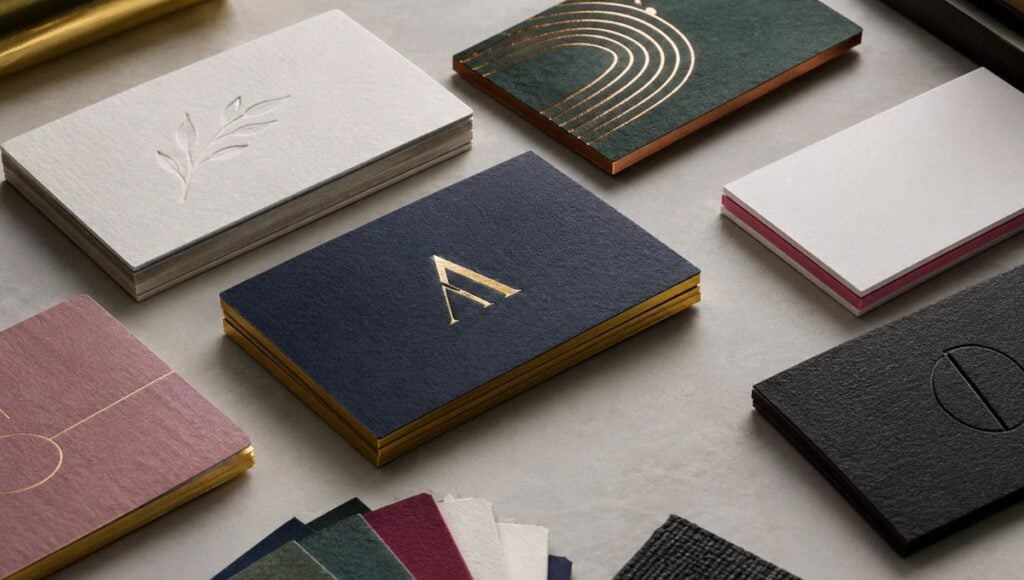
Triplex business cards consist of three bonded layers. In many designs, two outer sheets surround a contrasting middle layer, creating a visible strip of color along the trimmed edges. This colored core can introduce a brand accent without requiring the entire card to feature a bright background.
Although exact specifications depend on the selected materials and printer, both constructions can produce a noticeably thicker, more rigid card than many conventional alternatives.
Here are the principal differences:
- Layer count: Duplex uses two bonded sheets, while triplex uses three.
- Design flexibility: Both allow combinations of different papers, colors, and textures.
- Edge appearance: Triplex cards can feature a contrasting core visible around the perimeter.
- Thickness and structure: Additional layers create a more substantial card, depending on the paper and adhesive used.
- Finishing opportunities: Both constructions may support techniques such as foil stamping, letterpress, embossing, and edge coloring when the selected materials and production process are compatible.
The key distinction is that duplex and triplex describe how the card is constructed, rather than a particular printing method or surface finish. Designers can therefore develop a wide variety of visual styles using these techniques. The best construction depends on the intended appearance, the artwork, the desired tactile experience, and the practical requirements of the finished card.
Why Designers Love the Creative Possibilities of Layered Cards
One of the biggest advantages of duplex and triplex business cards is the freedom to treat the card as a combination of surfaces rather than a single piece of paper. Designers can use the front, back, and exposed edge to communicate a brand’s identity in coordinated but different ways. This is particularly valuable when a business wants stationery that feels distinctive without relying on complicated graphics or excessive decoration.
For example, a minimalist design could feature a clean white front with a discreet logo, a dark reverse carrying contact information, and a colored center layer that repeats the company’s signature accent. Another approach might combine natural kraft paper on one side with a smooth, bright stock on the other, creating a contrast between an organic aesthetic and a more polished presentation.
Layered construction also encourages designers to consider how people interact with a business card. Its weight, firmness, texture, and edge can all contribute to the experience of holding and examining it. These details are especially useful for brands that want their physical materials to reflect the quality and character of their services.
Designers can explore several creative approaches:
- Contrasting paper stocks: Pair smooth, textured, colored, or natural-looking papers to distinguish the two faces.
- Brand-colored cores: Use a contrasting middle layer to introduce a recognizable color around the card’s perimeter.
- Minimalist compositions: Let the material, typography, and proportions create visual interest without overcrowding the layout.
- Coordinated front-and-back designs: Give each side a different function while maintaining consistent typography and branding.
- Tactile contrasts: Combine suitable papers with finishes such as embossing or letterpress to create additional surface variation.
These options are not limited to luxury businesses. Creative agencies, photographers, architects, consultants, independent professionals, and boutique retailers may all benefit from a business card that expresses their brand more deliberately. The important consideration is whether the layered construction supports the design concept. When every material and color has a purpose, the result feels intentional rather than decorative for its own sake.
Premium Finishes That Complement Duplex and Triplex Business Cards
Layered business cards provide a substantial foundation for specialty printing finishes. Because the construction can involve different outer sheets and a thicker overall profile, designers have more opportunities to coordinate surface treatments with the underlying materials. However, the compatibility of any finish depends on the specific paper, production equipment, bonding method, and order in which the finishing steps are performed.
Foil stamping is one option for introducing metallic or colored accents. Gold, silver, copper, and other available foil colors can highlight a logo, monogram, or small typographic element. On a restrained design, foil can provide contrast without overwhelming the paper’s natural character.
Letterpress printing presses a design into a suitable paper surface, creating a tactile impression. It is often associated with understated, premium stationery because the depth and texture can make even a simple wordmark feel distinctive. Duplex construction can also help when deep impressions on opposite faces would otherwise interfere with one another, provided the printer selects an appropriate build.
Embossing and debossing offer another way to introduce physical dimension. Embossing raises a design above the surrounding surface, while debossing presses it into the material. These techniques can emphasize logos, decorative elements, or selected typography.
Edge treatments are equally important:
- Colored core: A contrasting middle sheet creates a built-in stripe around the edge of a triplex card.
- Edge painting: Color is applied to the trimmed perimeter, allowing the edge to coordinate with the brand palette.
- Metallic edge treatments: Where available and compatible, metallic finishes can create a more decorative perimeter.
- Rounded corners: A suitable corner treatment can soften the card’s silhouette, although the finishing sequence must accommodate the chosen construction.
- Matte or soft-touch surfaces: Compatible coatings or laminations can change the way the outer sheets look and feel.
The most effective approach is to choose finishes that complement rather than compete with one another. A triplex card with a colored core, for instance, may need only a simple logo and one carefully chosen accent. Combining multiple elaborate treatments can increase production complexity and cost without necessarily improving the design.
Before approving a final specification, designers should confirm that the selected paper stocks, adhesives, impressions, coatings, and edge treatments work together. Reviewing a physical sample is particularly helpful when the finished thickness, tactile quality, and edge color are central to the concept.
How to Design and Prepare Duplex and Triplex Business Cards for Printing
Creating an effective layered business card involves more than choosing a thicker stock. Designers must consider the entire construction, including how the front and back will be printed, which materials will be bonded, what the edges should look like, and how the final piece will be trimmed. Planning these details early can reduce production problems and help ensure that the finished card matches the original concept.
Start by establishing the brand’s priorities. A professional services firm might favor restrained typography and a subtle color core, while a creative studio could choose contrasting stocks or a more expressive edge treatment. The design should remain legible and functional, with names, contact details, and other essential information easy to find.
Next, select the construction according to the intended result. Duplex may be sufficient when the main objective is to combine two different surfaces or create additional thickness. Triplex may be preferable when a contrasting central layer is an important part of the visual identity. Neither option is automatically better; the decision should reflect the brief and production requirements.
Before sending artwork to print, review the following checklist:
- Confirm the finished dimensions: Use the printer’s specified trim size and document setup.
- Prepare separate front and back artwork: Clearly identify each side and ensure both files use consistent dimensions and orientation.
- Allow for bleed and safe margins: Extend artwork that reaches the edge beyond the trim line and keep important text and logos safely inside it, following the printer’s specifications.
- Specify the paper layers: Identify the intended stocks, colors, and surface characteristics for each layer.
- Define the core color: If the triplex design requires a colored center, specify it as part of the physical construction rather than assuming it can be reproduced through ordinary face printing.
- Separate specialty finishes: Supply clearly identified artwork or production layers for foil, embossing, debossing, or other special treatments as requested by the printer.
- Avoid fragile edge details: Thin borders placed close to the trim can appear uneven if minor cutting variations occur.
- Request a physical proof or sample: Whenever possible, evaluate the actual thickness, color relationships, paper texture, and finish before committing to a larger run.
Cost and practicality should also be part of the planning process. Additional paper layers require more materials and processing, while specialty finishes may introduce further setup requirements. Very thick cards can also be less convenient to carry in a conventional wallet. A designer should therefore balance the desired visual impact with the client’s budget, distribution needs, and intended use.
Working with an experienced printing partner early in the process makes it easier to assess available materials, confirm finishing compatibility, and prepare artwork correctly. That collaboration helps transform an attractive concept into a production-ready business card.
Conclusion
Duplex and triplex business cards give designers a versatile way to combine thickness, contrasting paper stocks, distinctive colors, and tactile finishes in a single branded piece. Duplex construction offers two layers that can create different surfaces on the front and back, while triplex adds a third layer that can introduce a striking colored core. When paired with thoughtful typography, appropriate materials, and compatible finishing techniques, these constructions can help businesses present a more considered and memorable identity.
The best results come from choosing each element with a clear purpose, from the paper and edge treatment to the final artwork and production specifications. If you are planning a new stationery collection or exploring business card design nyc, Japan Printing can help you bring your ideas together. Contact Japan Printing today to request a quote for your business card design and creation project, and take the next step toward business cards that reflect your brand with care and professionalism.