Business Cards 09.22.26
Business Cards for Small Businesses in NYC

Daniel Cantor
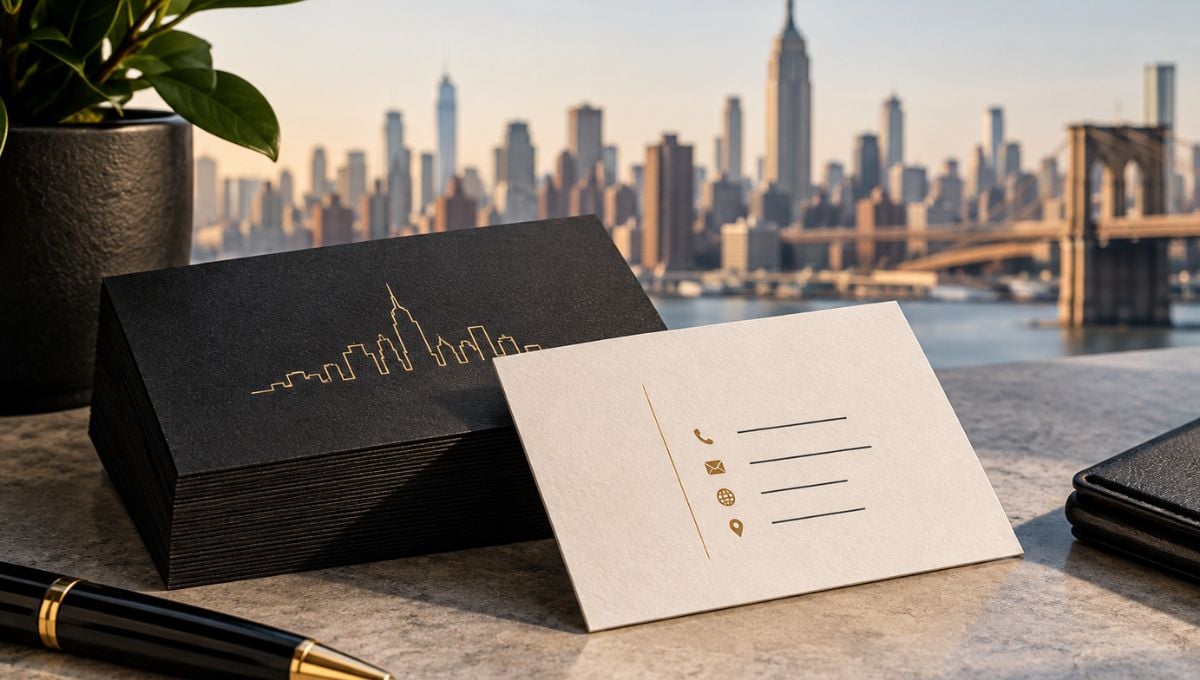
New York City is one of the most competitive environments for entrepreneurs, independent professionals, and local businesses. The city had more than 183,000 small businesses operating by 2025, according to the NYC Department of Small Business Services, while the city continues to have thousands of active storefront businesses across its neighborhoods. In that environment, a business card can serve as a compact extension of your brand whenever you meet a prospective customer, partner, vendor, or professional contact. Well-designed business cards in NYC can communicate your business name, services, contact information, and visual identity in a physical format that is easy to exchange and keep.
Whether you run a consulting firm in Manhattan, a restaurant in Queens, a creative studio in Brooklyn, or a service business in the Bronx or Staten Island, the right card should reflect your brand and make essential information easy to understand. If you are planning a new card or updating an existing design, contact Japan Printing to request a quote for your business card design and printing project and create a professional printed piece tailored to your business.
Why Business Cards Still Matter for NYC Small Businesses
Networking remains an important part of developing business relationships, even as companies increasingly rely on websites, email, social media, and digital contact tools. The U.S. Small Business Administration has specifically highlighted face-to-face networking as a way for businesses to build relationships and recommends arriving at networking events prepared with business cards and a concise description of what the business does.
For a small business in New York City, this can be especially relevant because opportunities to meet potential contacts occur in many different settings. A business owner may encounter a prospective client at a neighborhood event, industry conference, local business organization, trade show, restaurant, coworking space, or casual professional gathering. A digital profile can be useful, but a physical card gives the recipient something tangible to take with them.
The most useful small business cards NYC companies produce should make the next step obvious. Depending on the business, that could mean:
- Calling for an appointment or consultation.
- Visiting a physical location.
- Sending an email.
- Visiting the company’s website.
- Scanning a QR code.
- Following a social media account.
- Requesting a quote or service.
A business card also provides an opportunity to establish visual consistency. Your logo, typography, colors, photography, illustrations, and other visual elements can connect the card with your website, packaging, stationery, signage, and other marketing materials.
The goal is not simply to put as much information as possible onto a small piece of paper. Instead, the card should prioritize the information a recipient is most likely to need after the initial interaction. For a small company, that might mean emphasizing the owner’s name and phone number. For a design agency, the website and portfolio may deserve greater prominence. For a restaurant or retail business, location, website, and social media may be more relevant.
The right approach depends on how the business actually acquires customers and maintains relationships. That makes the design process an important part of creating effective business cards in NYC, rather than treating printing as an afterthought.
Choosing the Right Design for Small Business Cards NYC
A business card has very limited physical space, so design decisions have a disproportionate effect on how the information is perceived. The first step is establishing a clear hierarchy: the recipient should immediately understand whose card they are holding and what the business does without having to decode a crowded layout.
For many businesses, a practical information hierarchy could include:
Business name and logo
Owner or professional’s name
Job title or primary service
Phone number and email
Website
Address, when relevant
Social media or QR code, when useful
The design should also correspond with the character of the business. A financial professional may choose restrained typography and a clean layout, while a restaurant, fashion company, photographer, architect, or creative agency may have more opportunities to experiment with color, composition, imagery, or unusual formats.
Typography deserves particular attention because business cards are physically small. Extremely decorative fonts can make contact information difficult to read, particularly when printed at small sizes. Strong contrast between the text and background is similarly important.
Color should also be considered in relation to the rest of the company’s identity. If the business already has established brand colors, the card can reinforce those colors rather than introducing an unrelated palette. A consistent visual system can help connect the card to the company’s other customer touchpoints.
There is also room to use the back of the card strategically. Rather than simply repeating contact information, the reverse side could contain:
A short description of the business.
A service list.
A QR code.
A website or portfolio.
A simple brand graphic.
A promotional message.
A booking or appointment prompt.
For small business cards NYC entrepreneurs, simplicity can be particularly useful. The card does not need to communicate an entire marketing strategy. Its job can simply be to make the business memorable and provide an easy path to the next interaction.
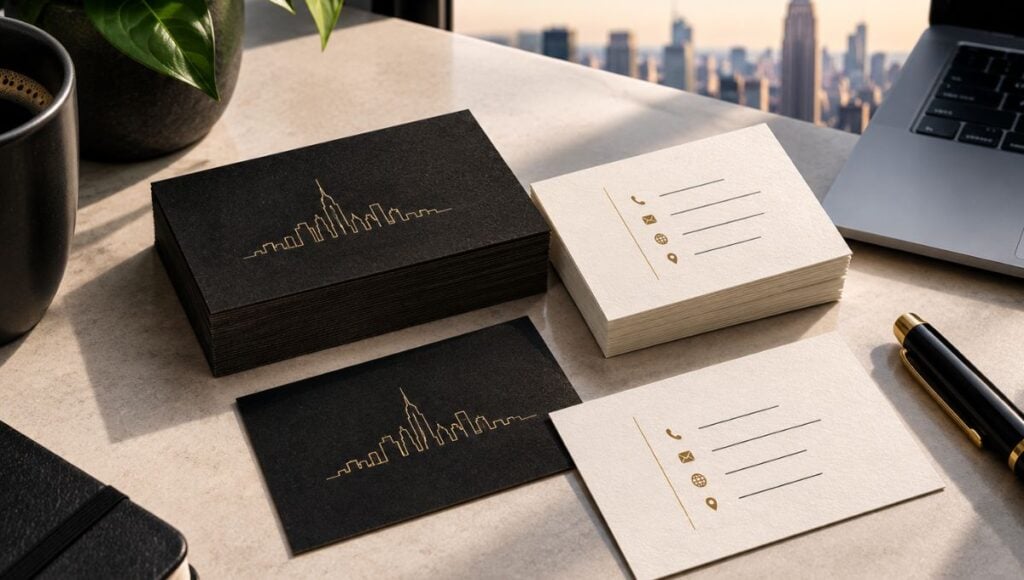
Paper, Finishes, and Printing Options for NYC Business Cards
Design is only one part of creating a business card. Paper stock, finishing, printing method, and production quality can significantly change the physical result.
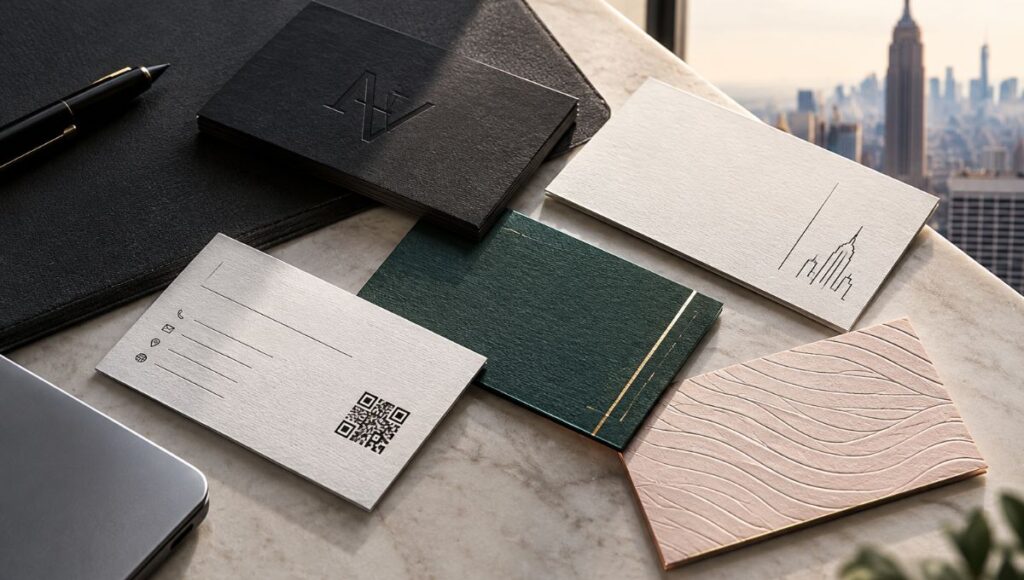
Different stocks can produce different impressions. A smooth stock can provide a clean, contemporary appearance, while textured papers can create a more distinctive tactile experience. Specialty finishes can also introduce additional visual or physical details without requiring a complicated graphic design.
Potential options include:
- Matte finishes: Often chosen for a clean and understated appearance.
- Gloss finishes: Can create a more reflective surface and emphasize photographs or saturated graphics.
- Soft-touch finishes: Provide a smoother tactile surface.
- Foil accents: Can be used selectively for logos, names, or other details.
- Embossing or debossing: Creates dimensional elements that can be felt as well as seen.
- Specialty papers: Provide texture or a distinctive physical character.
- Thicker stocks: Can create a more substantial card when that suits the brand.
There is no single finish that is appropriate for every company. A small accounting practice, a luxury interior designer, and a neighborhood restaurant may have completely different branding requirements. The material should therefore support the identity established by the design.
Production preparation matters as well. Adobe’s InDesign guidance recommends using a bleed when artwork extends to the edge of a printed piece and keeping important elements within a safe area. For a typical U.S. business card, printers commonly work with a 3.5 × 2-inch finished size and approximately 0.125-inch bleed, although specifications can vary by printer and format.
A professional prepress workflow should therefore verify details such as:
- Final trim dimensions.
- Bleed requirements.
- Safe margins.
- Image resolution.
- Color specifications.
- Font handling.
- Final PDF setup.
- Special finishing instructions.
These technical details may seem minor, but they affect whether the final cards accurately reproduce the approved design. For companies investing in business cards in NYC, professional design and careful production preparation help turn the digital artwork into a finished physical product.
How to Make Small Business Cards NYC Work as Part of Your Marketing
A business card is most useful when it is integrated into the way a company actually communicates with customers. Printing thousands of cards does not automatically create business opportunities; the card needs to support real interactions and make it easy for someone to continue the relationship.
Networking is one obvious application. The SBA recommends setting goals for networking activities, preparing an elevator pitch, and bringing enough business cards to events. For an NYC entrepreneur, this could include industry conferences, professional associations, neighborhood events, trade shows, business meetings, or local networking groups.
The card can also support other marketing channels. For example, a QR code can connect a physical card to a digital destination such as a website, portfolio, appointment page, menu, or contact form. This creates a bridge between the printed piece and the company’s online presence.
However, the destination should be considered carefully. A QR code that leads to a slow, confusing, or poorly optimized page adds friction rather than removing it. The landing page should provide a clear next action and work well on a smartphone.
Businesses can also organize different versions of their cards according to their audiences. For example:
A sales representative may emphasize direct contact information.
A creative professional may prioritize a portfolio URL.
A restaurant may highlight its location and menu.
A contractor may emphasize services and phone contact.
A consultant may feature a booking page.
A retailer may include its website and social platforms.
This approach makes small business cards NYC companies use more relevant to their actual customer journeys.
It is also worth reviewing the card periodically. If the phone number, address, website, services, branding, or social media handles change, outdated cards can become a liability. A new card design can also be an opportunity to bring printed materials into alignment with a redesigned website or broader brand identity.
Ultimately, business cards work best as one component of a larger marketing system. They can complement websites, email marketing, social media, signage, packaging, direct mail, networking, and other customer-facing materials rather than functioning independently.
Conclusion
For NYC entrepreneurs, a business card is a small physical format with several jobs: identify the business, communicate essential information, reinforce the brand, and provide a practical way for a new contact to continue the conversation. With more than 183,000 small businesses operating in New York City according to city data published in 2025, businesses compete for attention across a wide range of industries and neighborhoods. Thoughtful typography, clear information hierarchy, appropriate paper, professional finishing, and accurate print preparation can help create business cards in NYC that fit naturally into a company’s broader identity.
Whether you are launching a new company, refreshing an established brand, or simply replacing outdated cards, Japan Printing can help with the design and production process. Request a quote from Japan Printing for your business card project and explore professionally designed and printed small business cards NYC businesses can use for networking, customer outreach, and everyday brand communication.