Stationery 11.05.26
Paper Grain Direction: The Tiny Detail That Can Make or Break a Premium Print Job

Daniel Cantor
When designing premium printed materials, most people focus on typography, colors, paper weight, finishes, and overall aesthetics. However, there is another technical detail that can significantly influence the final result: paper grain direction. Although it is practically invisible to the naked eye, the direction in which paper fibers are aligned affects how a sheet bends, folds, handles moisture, and performs during different printing and finishing processes. Overlooking this characteristic can lead to unwanted cracking, uneven folds, production complications, and a less refined final product.
For businesses investing in professional stationery and business cards, understanding paper grain is an important step toward achieving consistent, high-quality results. Whether you are developing custom stationery or exploring business card design nyc, choosing the right materials and preparing them correctly can make a noticeable difference. At Japan Printing, we combine thoughtful design with professional printing expertise to help businesses create distinctive printed materials. Contact Japan Printing today to request a quote for your business card design and printing project.
What Is Paper Grain Direction and Why Does It Matter?
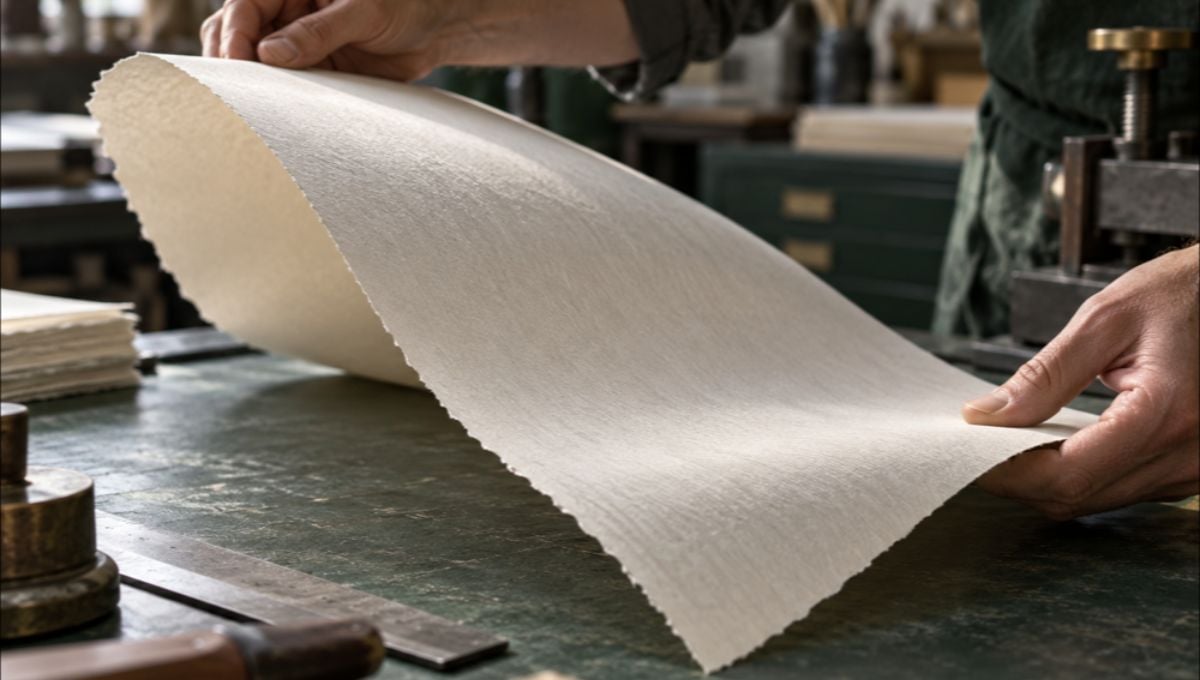
Paper grain direction refers to the predominant alignment of fibers within a sheet of paper. During manufacturing, paper pulp travels through a moving mesh or forming system. As water drains from the pulp, many of the fibers tend to align with the direction of the machine. This creates a directional structure that influences how the finished sheet behaves.
Although paper may appear uniform, its physical properties are not identical in every direction. It generally bends, folds, and tears differently depending on whether the action follows the grain or crosses it. Understanding this distinction is particularly important when working with thick cardstock, specialty papers, and printed materials that require additional finishing.
There are two main grain classifications:
- Long grain: The fibers run parallel to the longer dimension of the sheet.
- Short grain: The fibers run parallel to the shorter dimension of the sheet.
These classifications describe the relationship between the fibers and the sheet dimensions, not the overall quality or thickness of the paper.
Why does this matter in professional printing? Because the grain influences several characteristics that can affect production:
- Folding behavior: Paper generally folds more smoothly when the fold runs parallel to the grain.
- Stiffness: Paper exhibits different bending characteristics depending on the direction of the grain.
- Dimensional stability: Paper typically responds differently to moisture changes along and across the grain.
- Print production: Grain orientation can influence sheet feeding, handling, and registration during certain printing processes.
- Finishing quality: Scoring, folding, and binding may require specific grain orientations to achieve a clean result.
For premium stationery, these characteristics should be considered during material selection and production planning. A beautiful design cannot compensate for every material-related problem, especially when the paper must also withstand folding, handling, or mechanical finishing.
How Grain Direction Affects Folding, Scoring, and Premium Finishes
One of the most noticeable consequences of incorrect grain orientation appears during folding. When paper is folded parallel to its grain, the fibers generally accommodate the bend more easily. Conversely, folding across the grain places greater stress on the paper structure, potentially producing rough edges, visible cracking, or fibers separating along the crease.
This issue becomes especially relevant with heavier cardstock and coated papers. The coating and printed ink layer can also crack when the underlying sheet is bent, exposing the lighter paper beneath the printed surface. The result may be particularly noticeable in dark-colored designs, where even a small crack can interrupt the appearance of an otherwise sophisticated printed piece.
Scoring is another important consideration. Scoring involves creating a controlled indentation along a predetermined line to help thicker paper fold more cleanly. It reduces the stress associated with bending the sheet and can improve the appearance of the finished crease. However, scoring does not eliminate every problem associated with an unsuitable grain direction.
Several finishing considerations deserve attention:
- Scoring and creasing: These processes help control where thicker cardstock bends, particularly when working with heavier stocks.
- Foil stamping: Designs should be evaluated for how folds and creases interact with areas containing foil, since cracking or surface damage can compromise the appearance.
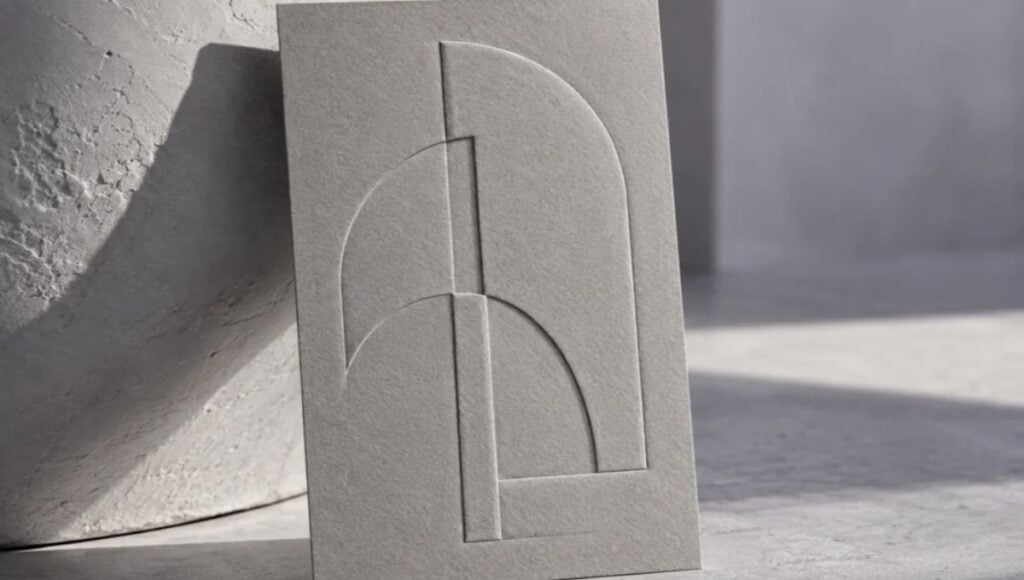
- Embossing and debossing: Raised and recessed details require careful consideration of paper construction, thickness, and finishing conditions.
- Lamination and coatings: Additional surface layers may influence how the finished material behaves when bent.
- Folding consistency: Correct grain orientation helps produce cleaner, more predictable folds across a production run.
Sappi’s technical guidance on folding and scoring emphasizes the importance of making folds parallel to the paper grain to reduce fiber stress. It also explains that printing conditions, moisture, and ink characteristics can influence folding performance.
For premium stationery, the lesson is straightforward: finishing techniques should never be selected independently of the paper itself. The stock, grain direction, printed coverage, and finishing method need to work together to achieve the intended appearance.
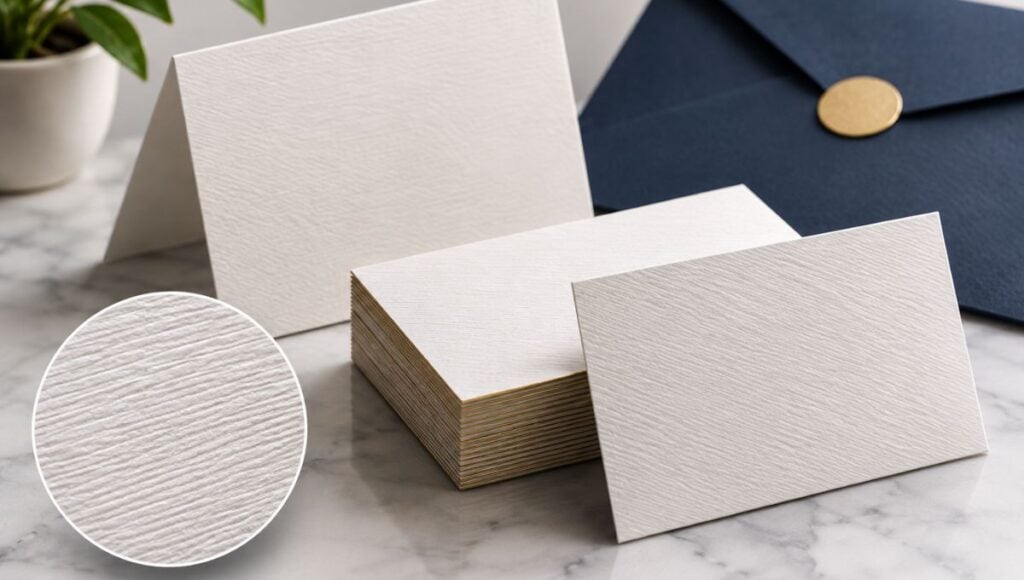
Paper Grain Direction in Business Cards and Premium Stationery
Business cards are typically flat printed products, so grain direction is not always as critical as it is for folded brochures, booklets, or greeting cards. A standard business card does not necessarily require a particular grain orientation simply because of its dimensions. However, grain direction can still influence the handling and production of thicker cardstock, especially when the project involves specialized construction or additional finishing.
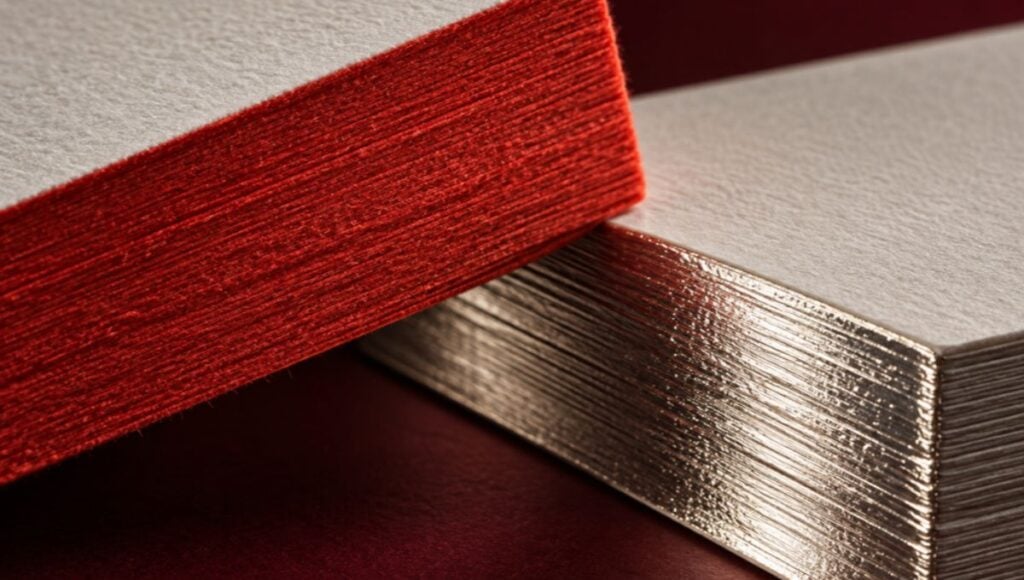
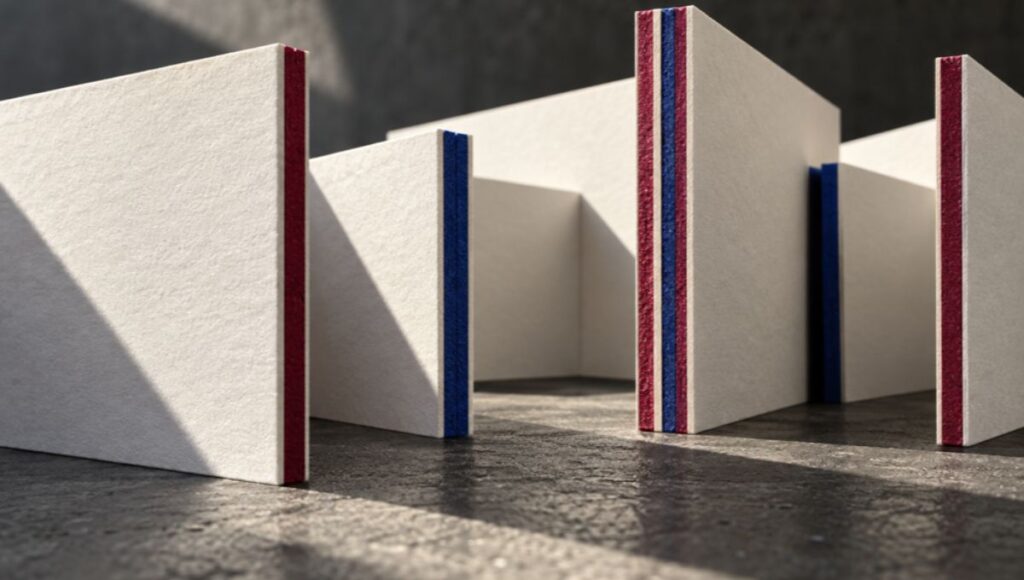
For example, duplex and triplex business cards are made by bonding multiple paper layers to create a thicker, more substantial card. These constructions require careful material selection and production control. The orientation of each layer, the adhesives, the paper characteristics, and the intended finishing process should be evaluated together rather than assuming that grain direction alone determines the result.
Grain direction is also worth considering when producing stationery products such as:
- Folded business cards: The direction of the fold should be evaluated in relation to the grain to reduce cracking and achieve a cleaner crease.
- Letterheads and envelopes: Paper orientation can influence stiffness, handling, and performance during printing and converting.
- Presentation folders: Folding lines and structural components should be planned with the paper grain in mind.
- Greeting cards and invitations: A suitable grain orientation helps create smoother folds, especially when using heavier or textured cardstock.
- Custom stationery sets: Different components may require different paper orientations depending on their dimensions and finishing requirements.
Another consideration is the relationship between paper grain and the overall production process. A particular orientation may be desirable for finishing, while the printer’s sheet-feeding requirements may favor another arrangement. This is why professional print production involves evaluating the entire workflow rather than choosing paper based exclusively on its weight or appearance.
For businesses ordering premium business cards, the most important consideration is ensuring that the chosen cardstock is compatible with the printing and finishing specifications. A professional printer can evaluate whether grain direction is relevant to the particular construction, helping prevent avoidable production issues while preserving the intended design.
How to Identify Paper Grain Direction Before Printing
Identifying paper grain direction before production helps designers and printers make more informed decisions about material selection, sheet layout, and finishing. Ideally, the direction should be confirmed through the paper manufacturer’s documentation or the supplier’s specifications. However, there are also practical methods for examining an unmarked sheet.
One commonly used approach is the folding test. Take a sample sheet and gently bend it in one direction without creating a permanent crease. Repeat the process in the perpendicular direction. The sheet generally bends more easily and produces a smoother fold when the bend follows the grain.
Other methods include:
- Checking the packaging: Paper manufacturers and suppliers may identify the grain orientation through labels, abbreviations, or sheet dimensions.
- Performing a tear test: Paper typically tears more cleanly and in a straighter line along the grain than across it.
- Comparing bending resistance: Gently curve the sheet in both directions and observe which direction offers less resistance.
- Consulting technical specifications: Manufacturer documentation can provide more reliable information about the paper’s machine direction and physical characteristics.
These practical tests are useful indicators, but they should not replace supplier documentation or appropriate technical testing when a production specification requires a confirmed orientation.
Before approving a premium print job, designers and printers should also consider the following checklist:
- Confirm the paper stock: Identify the exact paper type, thickness, coating, and manufacturer specifications.
- Establish the grain direction: Determine whether the stock is long grain or short grain.
- Review the design layout: Identify any folds, creases, or structural elements that could be affected by the grain.
- Evaluate the printing process: Check whether the proposed orientation is compatible with the equipment’s feeding and handling requirements.
- Request a physical proof: Test the actual stock with the intended printing and finishing techniques whenever possible.
- Inspect the finished sample: Look for cracking, uneven folds, surface damage, and other inconsistencies before approving full production.
Testing is particularly valuable when working with unfamiliar specialty stocks, unusual paper constructions, or premium finishing combinations. Rather than assuming that every paper behaves identically, a physical sample allows the production team to evaluate the actual material under the intended conditions.
Conclusion
Paper grain direction may be a small technical detail, but it can have a meaningful impact on the quality, durability, and appearance of printed materials. From preventing cracked folds to improving production consistency, understanding how paper fibers behave helps designers and printers make better decisions throughout the printing process. Although standard flat business cards do not always require a specific grain orientation, more complex constructions and specialty stationery projects benefit from evaluating this characteristic before production begins. Ultimately, premium printing is about more than selecting beautiful paper or sophisticated finishes; it is about understanding how every material and production detail contributes to the final result.
At Japan Printing, we believe exceptional printed materials begin with thoughtful design, informed material selection, and attention to detail at every stage. Whether you need elegant corporate stationery, custom business cards, or premium printed materials that represent your brand, our team is ready to help bring your ideas to life. Contact Japan Printing today to request a quote for your business card design and printing project, and discover how the right combination of design, materials, and craftsmanship can elevate your brand.