Stationery 09.05.26
Digital Fatigue Is Real: Why Physical Marketing Is Getting Attention Again

Daniel Cantor
Consumers spend an enormous portion of their lives surrounded by screens: emails, social media feeds, digital advertisements, notifications, text messages, and endless streams of branded content. The result is a marketing environment where getting attention is increasingly difficult. Recent consumer research from Lob found that 58% of consumers feel overwhelmed by digital brand messages, while 53% say direct mail feels more special, valuable, or exclusive. At the same time, 84% of consumers surveyed said they read direct mail immediately or on the same day they receive it. This does not mean digital marketing is disappearing. Instead, it suggests that physical marketing can provide something digital channels increasingly struggle to offer: a tangible experience.
For businesses, this creates an opportunity to make physical materials part of a broader marketing strategy rather than treating print as outdated. From carefully designed mailers and premium stationery to memorable business cards, physical materials can give a brand something customers can hold, examine, keep, and remember. If you are looking to strengthen your brand with professionally designed and printed materials, Japan Printing can help you create everything from distinctive stationery to premium business cards in NYC. Contact our team to request a quote for your next design and printing project.
Digital Fatigue Is Changing the Value of Physical Marketing
Digital marketing remains extremely important, but consumers are increasingly exposed to an extraordinary volume of digital communication. Every day, people move between email inboxes, social platforms, websites, search engines, messaging applications, streaming services, and mobile notifications. The problem for marketers is not necessarily a lack of available channels; it is the competition for attention within those channels.
Research conducted by Lob in 2025 illustrates this tension. Its survey of 2,000 U.S. adults found that 58% felt overwhelmed by digital brand messages. At the same time, 53% said direct mail felt more special, valuable, or exclusive than other communications.
That difference matters because physical marketing changes the context in which a brand is encountered. An email can disappear beneath dozens of other messages. A social media advertisement can be replaced within seconds. A printed piece, however, exists in the physical environment and can remain visible on a desk, countertop, reception area, or coffee table.
Research discussed by MIT Sloan Management Review also points toward this distinction. A study comparing physical direct mail with major digital advertising platforms examined customer acquisition, purchase behavior, and return on advertising spend, illustrating how physical marketing can remain competitive even in highly digital environments.
For businesses, physical marketing can therefore serve several purposes:
- Breaking digital patterns: A physical piece arrives in an environment where consumers are not constantly scrolling.
- Creating a tangible brand experience: Paper, texture, weight, typography, and finishing all contribute to perception.
- Increasing memorability: Physical materials can remain visible after the initial interaction.
- Supporting personal interactions: Business cards and printed stationery can extend a conversation beyond the moment when it occurs.
- Differentiating premium brands: High-quality printing can communicate positioning before a customer reads the actual message.
This is particularly relevant for businesses competing in crowded markets such as New York City. When every competitor has a website, Instagram profile, email campaign, and digital advertisement, a well-designed physical identity can become a differentiator. That is one reason demand for luxury business cards nyc continues to make sense as part of a broader brand strategy: the card is not merely a contact-information carrier; it can become a physical representation of the company’s positioning.
The opportunity is not to replace digital marketing with print. It is to use physical materials precisely because digital communication is everywhere.
Physical Materials Create Experiences Digital Ads Cannot Fully Reproduce
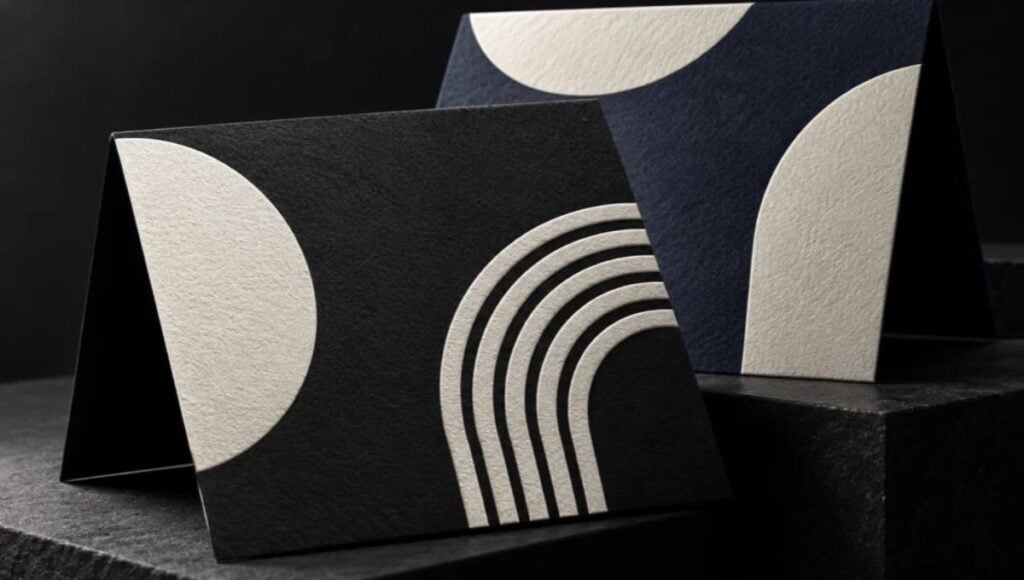
One of the most important advantages of physical marketing is its sensory dimension. Digital content is primarily experienced through a screen, while printed materials can engage sight and touch simultaneously. Paper stock, thickness, texture, coatings, embossing, foil, die-cutting, and other finishing techniques can all influence how a recipient perceives a brand.
Research from the U.S. Postal Service Office of Inspector General has previously examined the neurological response to physical versus digital advertising. The research found that participants processed digital advertisements more quickly, but spent more time with physical advertisements. Physical advertisements also generated stronger emotional responses and better memory in the study.
That distinction is valuable for designers and marketers. Speed is not always the same as impact.
A digital advertisement may win a fraction of a second of attention, but a printed piece can invite a person to physically interact with it. Someone can turn over a business card, feel its thickness, notice its texture, examine a special finish, and place it in a wallet or on a desk.
This is particularly powerful when the physical object has been designed intentionally.
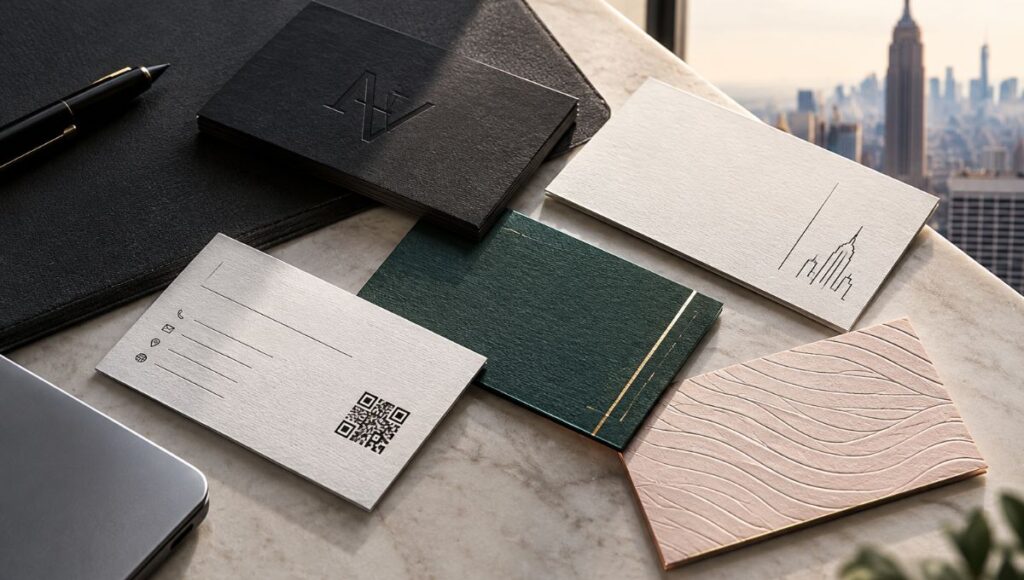
For example, a premium business card can incorporate:
- Thick or layered stocks that create a substantial feel.
- Embossed or debossed elements for tactile contrast.
- Foil accents for selective visual emphasis.
- Soft-touch or specialty coatings.
- Minimal typography that reinforces a luxury positioning.
- Unusual shapes or edges that make the card distinctive.
- Carefully selected paper textures that complement the brand identity.
These choices are not simply decorative. They help transform a printed object into a brand experience.
That is where luxury business cards nyc can play an especially interesting role. In competitive industries such as real estate, architecture, finance, hospitality, fashion, consulting, and creative services, the physical presentation of a brand can influence how professionalism and quality are perceived.
The same principle applies to nyc business card services more broadly. A business card should not be considered independently from the rest of the company’s identity. Typography, colors, logo treatment, paper selection, finishing, and information hierarchy should work together to communicate a coherent message.
Physical marketing also has another advantage: it can exist beyond the original interaction. A recipient might keep a business card for months, pin a printed invitation to a board, leave a promotional postcard on a desk, or save a beautifully designed piece because it is useful or visually appealing.
The strongest print marketing therefore does not simply reproduce a digital advertisement on paper. It takes advantage of what paper can uniquely do.
Print Is Becoming More Powerful When It Works With Digital
The return of physical marketing does not mean companies should abandon digital strategies. In fact, some of the strongest evidence suggests that physical and digital channels can work better together.
USPS reports that its own omnichannel campaigns performed better when direct mail was incorporated into the marketing mix. According to USPS, campaigns that included direct mail generated more revenue than digital-only campaigns, and adding direct mail to digital campaigns more than doubled overall revenue in its multi-year analysis.
The ANA’s direct-mail research similarly shows how physical campaigns are increasingly integrated with digital measurement. In its reported findings, 82% of respondents who track direct-mail response rates used online tracking mechanisms such as QR codes, personalized URLs, or other digital tools, up from 67% in the previous study.
This creates a powerful hybrid model.
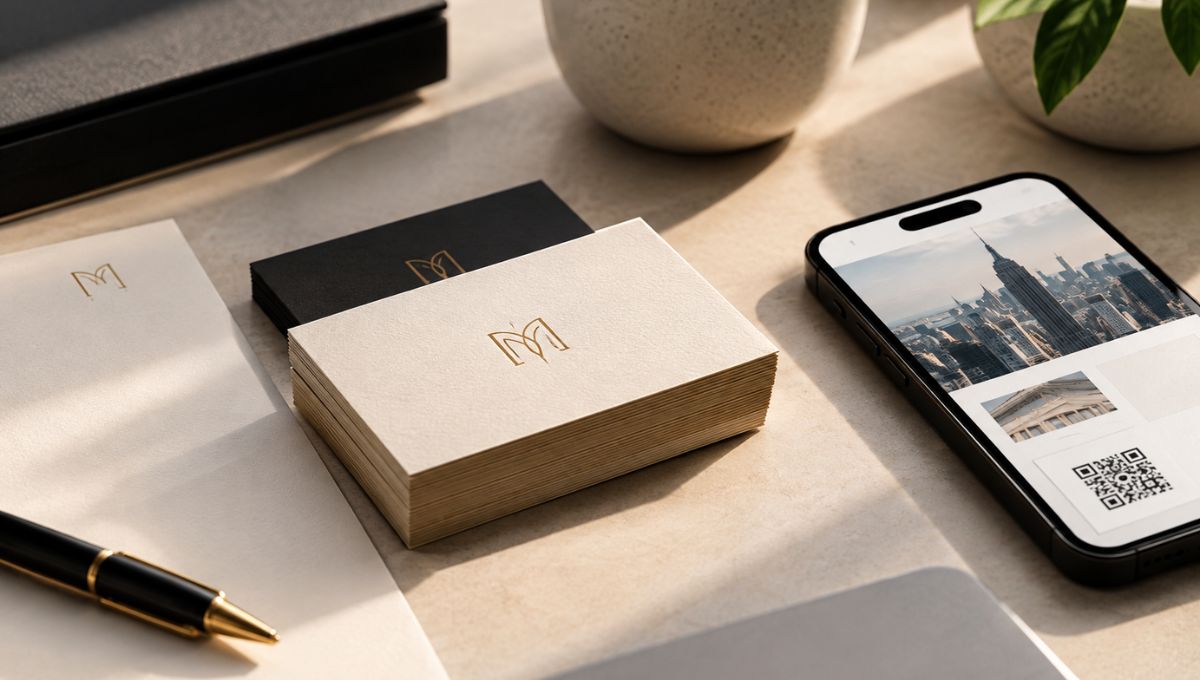
A printed postcard, for example, can contain a QR code leading to a landing page. A business card can direct someone toward a portfolio, online store, booking system, or social profile. A printed promotional piece can introduce a campaign while digital advertising reinforces the same message afterward.
A modern print campaign can therefore follow a structure such as:
- Physical introduction: A customer receives a printed piece.
- Digital interaction: A QR code or URL directs them to an online destination.
- Digital follow-up: Retargeting, email, or social content reinforces the campaign.
- Physical reinforcement: Additional printed materials support the customer relationship.
- Measurement: Digital interactions provide measurable data about campaign performance.
This approach is especially useful because print does not have to compete with digital for the same function. Each medium can perform a different job.
A business card, for instance, is particularly effective during an in-person interaction. It provides a physical reminder of a conversation while giving the recipient an easy way to reconnect digitally. Similarly, premium stationery can reinforce professionalism during proposals, correspondence, packaging, or client communications.
For brands investing in nyc business card services, this means the question should not simply be, “What should my business card look like?” A better question is, “How does my physical identity connect with everything customers see online?”
The same thinking applies to luxury business cards nyc. A sophisticated card should feel consistent with the company’s website, social media, packaging, presentations, and other touchpoints. When physical and digital branding share the same visual language, customers encounter one coherent brand rather than a collection of disconnected marketing materials.
The future of print is therefore not necessarily analog versus digital. It is increasingly about integration.
Why Premium Design Matters More When Physical Marketing Is Selective
The fact that consumers are paying more attention to physical marketing does not mean that every printed piece will automatically be effective. In fact, digital fatigue can make quality even more important.
Lob’s 2025 consumer research found that irrelevance was the leading reason direct mail failed. The same study found that 67% of consumers said relevance, including appropriate timing and personalization, drives them to take action.
This is an important distinction. Physical marketing is not valuable simply because it is physical. A poorly designed, irrelevant postcard can still end up in the trash.
The goal should be to create something that deserves attention.
That requires thinking carefully about several elements:
- Audience: Who will receive the piece?
- Purpose: Is the goal awareness, conversion, retention, networking, or brand positioning?
- Design: Does the visual system communicate the intended personality?
- Material: Does the paper support the positioning of the brand?
- Message: Is the information immediately relevant?
- Call to action: Does the recipient know what to do next?
- Digital connection: Can the recipient easily continue the interaction online?
This is where professional design and printing become particularly valuable.
For a luxury-oriented brand, for example, a generic thin business card may undermine the positioning established by the company’s website and advertising. Conversely, a carefully produced card with appropriate stock, typography, spacing, and finishing can reinforce the impression of quality.
That is why businesses exploring luxury business cards nyc should think beyond simply selecting the thickest paper available. Luxury is not synonymous with excess. The best result often comes from matching materials and finishing to the brand’s personality.
The same applies to nyc business card services. Professional printing should begin with design decisions rather than treating production as an afterthought. A printer and designer can help determine whether a particular typeface, color combination, paper, coating, or finishing technique will produce the intended result.
Physical marketing also benefits from restraint. If a consumer is already overwhelmed by digital messages, a printed piece covered in unnecessary information is unlikely to solve the problem. Strong hierarchy, clear messaging, whitespace, and distinctive but purposeful design can make a physical communication easier to understand.
There is also evidence that direct mail remains a significant part of the U.S. marketing ecosystem. USPS reported that nearly 3 billion pieces were sent through its Every Door Direct Mail program during fiscal year 2025. At the same time, the USPS Office of Inspector General notes that overall mail volumes have declined substantially because of digital alternatives and projects additional declines through 2035.
That combination is revealing: print is not returning because digital has disappeared. It is becoming strategically interesting precisely because digital dominates so much of modern communication.
For brands, the opportunity is to use physical marketing selectively, creatively, and with enough design quality to make the interaction meaningful.
Conclusion
Digital marketing is not going away, but consumers are becoming more selective about what deserves their attention. Research showing widespread digital-message fatigue, strong engagement with direct mail, and the effectiveness of combining physical and digital campaigns suggests that print can play a valuable role in a modern marketing strategy. From direct mail and stationery to premium business cards in NYC, physical materials can create experiences that are difficult to replicate through a screen alone.
The key is not simply printing more—it is printing with purpose. If your business is ready to turn its brand identity into professionally designed physical materials, Japan Printing can help with everything from custom stationery to luxury business cards nyc and complete nyc business card services. Contact Japan Printing today to request a quote for your next design and printing project and discover how the right physical materials can make your brand more memorable.