Business Cards 10.05.26
How to Choose Premium Business Cards in NYC: Materials, Finishes, Thickness & Pricing

Daniel Cantor
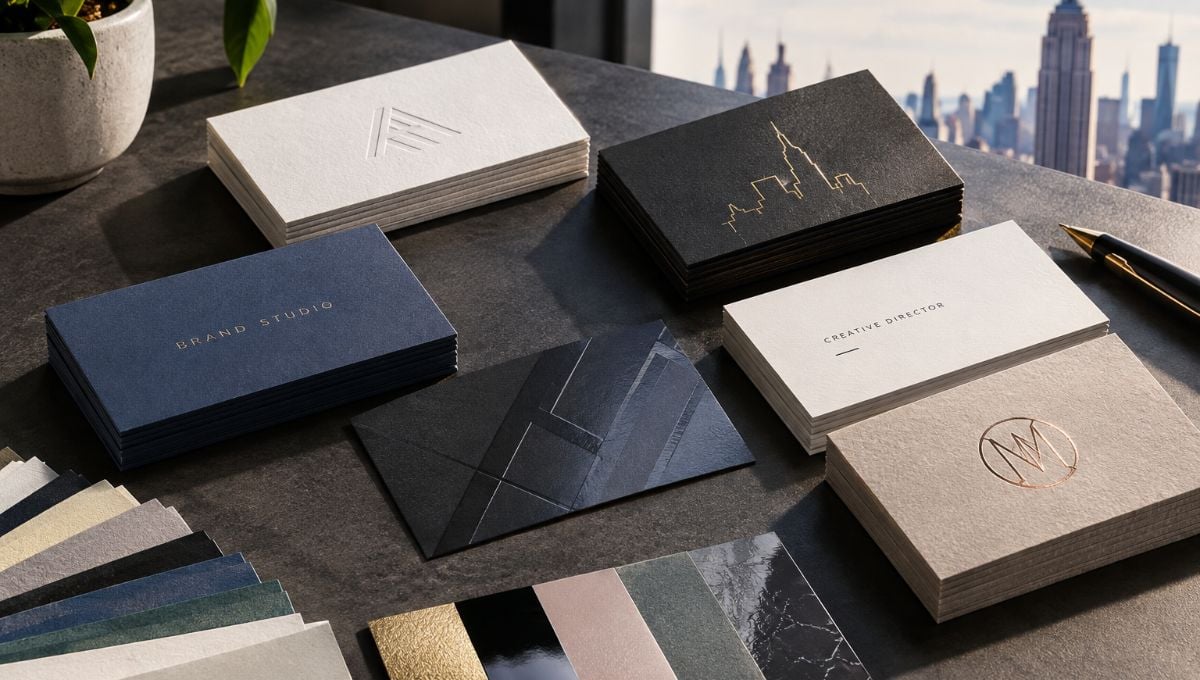
Choosing premium business cards is about more than simply selecting the thickest paper or adding a metallic finish. For professionals and businesses in New York City, the right card should balance material, thickness, finish, visual identity, usability, and budget. Whether you are attending networking events in Manhattan, meeting clients in Brooklyn, or building a luxury brand in NYC, the physical quality of your business card can reinforce the impression created by your brand. Today, printers offer everything from 16pt and 18pt coated stocks to cotton papers, multilayered 32pt stocks, foil, spot gloss, soft-touch coatings, and other specialty treatments.
If you are looking for premium business cards NYC businesses can use to make a stronger impression, the best approach is to choose each specification according to your brand rather than automatically selecting the most expensive option. At Japan Printing, we help businesses combine professional design with high-quality printing to create stationery that represents their brand effectively. Request a quote for your business card design and printing project with Japan Printing and let our team help you choose the right combination of materials, finishes, and production options.
Choose the Right Material and Paper Stock for Your Brand
The foundation of a premium business card is the paper stock. Paper affects how the card looks, how colors reproduce, how rigid it feels, and what finishing techniques can be applied. There is no single material that is universally “best”; the right choice depends on the personality and practical requirements of the brand.
For example, coated stocks can provide a smooth surface that works particularly well with photography, saturated colors, and contemporary branding. Uncoated papers offer a more natural tactile experience and can be especially appropriate for businesses that want an understated, sophisticated appearance. Cotton paper is another premium alternative. MOO, for example, describes its cotton business cards as being made from 100% cotton linters, with an uncoated, naturally bright-white and subtly textured surface.
When comparing materials for business cards in NYC, consider the following:
Coated paper: Smooth and polished, suitable for colorful or image-heavy designs.
Uncoated paper: More natural and tactile, with a softer visual character.
Cotton paper: Distinctive texture and a refined, natural feel.
Layered stocks: Multiple paper layers can create exceptionally thick cards and colored edges.
Premium coated stocks: Useful when you want durability combined with a smooth, contemporary finish.
Thickness and material should also work together. A very thick card can communicate quality, but excessive thickness may not be necessary for every profession. A creative agency, luxury real-estate firm, architect, lawyer, restaurant, fashion company, or financial professional may each benefit from different combinations.
For instance, MOO currently offers 16pt Original, 18pt Super, 17pt Cotton, and 32pt Luxe business-card stocks, demonstrating how substantially the physical experience can vary between premium options.
The goal should therefore be to select a stock that supports your brand positioning, rather than simply choosing the heaviest available option.
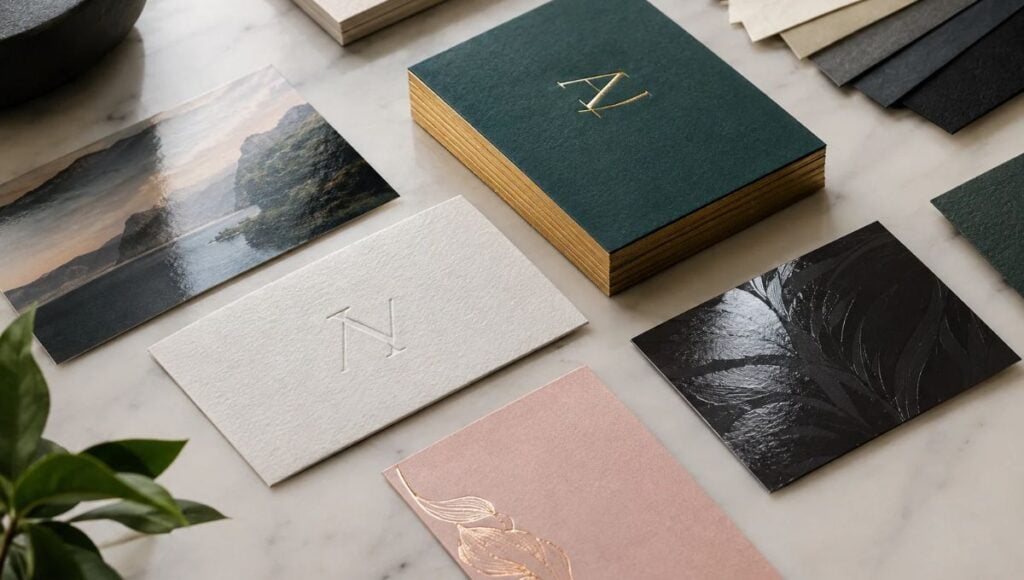
Understand Finishes: Matte, Soft Touch, Gloss, Foil and Spot Gloss
Once you have selected the paper, the finish can dramatically change the character of your business card. Finishes influence both appearance and tactile experience, making them particularly important when you are investing in premium business cards NYC customers will physically handle.
A matte finish reduces glare and creates a restrained, contemporary appearance. It can work particularly well for minimalist designs, professional services, and brands that want their typography and layout to remain the focus. Gloss provides considerably more visual shine and can make photographs and vivid colors appear more prominent. MOO currently offers both matte and gloss options on its 16pt Original stock.
A soft-touch finish takes the tactile experience further. It creates a smooth, velvety surface and is frequently paired with specialty treatments. MOO’s 18pt Super stock, for example, is available with Soft Touch or High Gloss, while its Soft Touch version can accommodate gold foil, silver foil, spot gloss, and raised spot gloss.
Some of the most popular premium treatments include:
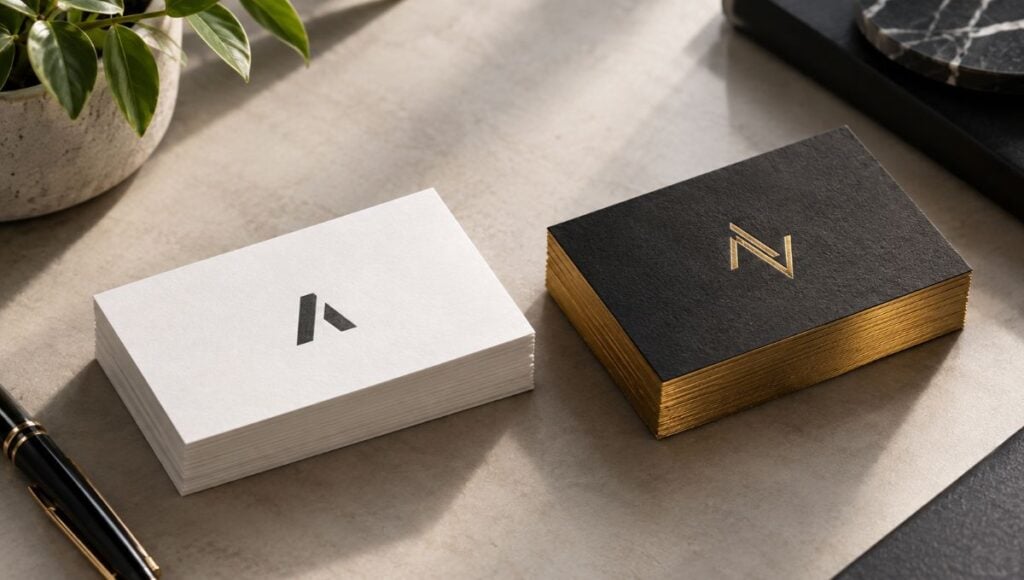
Gold foil: Adds a reflective metallic gold element to selected areas.
Silver foil: Creates a cooler metallic effect that can complement modern branding.
Spot gloss/spot UV: Adds transparent shine to specific portions of the design.
Raised spot gloss: Adds both shine and physical dimension.
Soft touch: Creates a smooth, velvety tactile surface.
Letterpress or debossing: Creates a physically impressed effect in appropriate paper stocks.
Special finishes are most effective when they have a clear design purpose. For example, foil can emphasize a logo, while spot gloss can highlight a pattern or selected typography. MOO recommends treating specialty finishes as accents rather than covering large areas of the design, and its current special-finish guidelines require separate artwork for the finish layer.
This is why professional design matters. A premium finish cannot compensate for poor hierarchy, excessive decoration, or an unclear brand message. The strongest premium cards usually use specialty effects selectively.
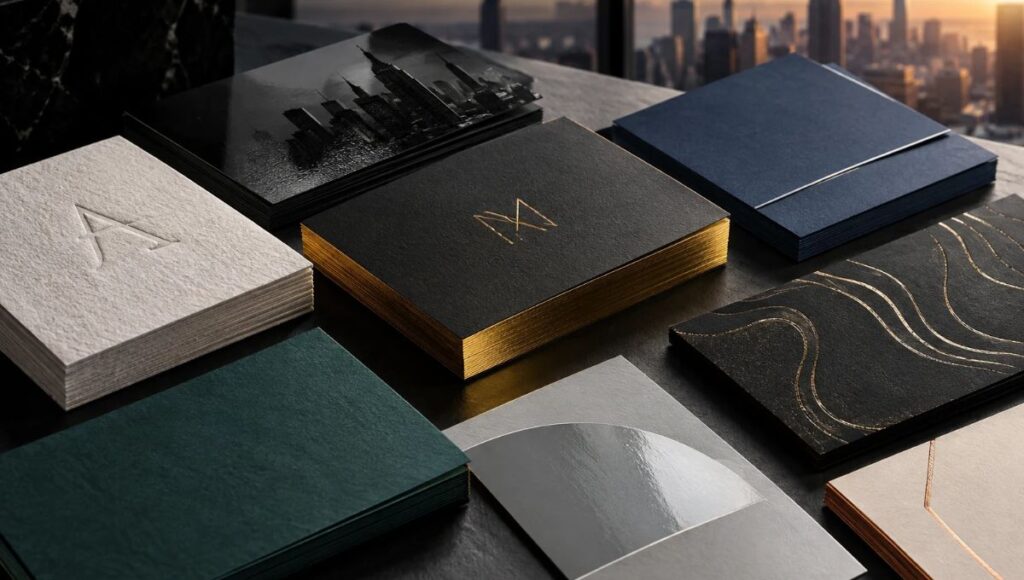
Select the Right Thickness: 16pt, 18pt, 32pt and Beyond
Thickness is one of the easiest characteristics to notice when someone receives a business card. However, “thicker” does not automatically mean “better.” The ideal thickness depends on the impression you want to create, the printing process, the chosen finish, and how the cards will be used.
For a contemporary premium card, 16pt can already provide a substantial feel compared with lightweight stocks. MOO describes its 16pt Original stock as thicker than a typical business card. Its 18pt Super stock provides additional rigidity while remaining relatively slim, while its 32pt Luxe stock is constructed from multiple layers of Mohawk Superfine paper for a substantially thicker, more rigid card.
A useful way to think about thickness is:
Around 14–16pt: Professional and versatile; suitable for many everyday business applications.
Around 17–18pt: More substantial and rigid, making it appropriate for many premium applications.
30pt+ layered stocks: Dramatic, highly tactile, and particularly suitable when physical presence is central to the brand.
Specialty constructions: Can introduce additional characteristics such as colored edges, texture, or dimensional effects.
For example, MOO’s Luxe cards use a 32pt, four-layer construction with a colored seam between the outer sheets. The resulting card is substantially thicker and more tactile than its other business-card stocks.
But there are trade-offs. Extremely thick cards may take up more space in wallets and cardholders, while certain specialty finishes are only compatible with particular paper stocks. MOO’s Luxe stock, for example, is uncoated and does not support some of the special glossy and foil treatments available on its Super stock.
Therefore, when ordering premium business cards NYC professionals can use for networking, consider the complete specification rather than thickness alone. An 18pt card with a carefully selected soft-touch finish and restrained foil treatment may communicate more sophistication than a much thicker card covered in unnecessary effects.
Compare Pricing and Build a Premium Card Within Your Budget
Pricing is where the differences between standard and premium business cards become particularly important. The final cost is influenced by more than paper thickness. Quantity, stock, printing method, finishing, card size, special treatments, design requirements, and production specifications can all affect the price.
Current online pricing provides useful benchmarks, although it should not be treated as a universal NYC printing price. For example, MOO currently lists its 16pt Original business cards starting at $23 for 50 cards, while its 18pt Super cards start at $33 for 50. Its Luxe 32pt cards start at $43 for 50. Specialty-finish cards such as gold foil, silver foil, spot gloss, and raised spot gloss currently start at $51 for 50 cards, while its letterpress cards start at $60 for 50.
These examples illustrate an important principle: premium pricing is usually driven by the combination of materials and production processes, not simply by the word “premium.”
When establishing a budget, consider:
Quantity: Larger quantities can reduce the per-card cost.
Paper stock: Heavier or specialty stocks generally cost more.
Finish: Foil, spot gloss, and raised treatments require additional production processes.
Design: Custom design and artwork preparation can add to the overall project.
Size and shape: Nonstandard formats or specialty cutting may increase production costs.
Turnaround: Rush production may carry additional charges.
Shipping: Delivery should be included when calculating the true project budget.
For a small business, it may make more sense to invest in an excellent 16pt or 18pt stock with one carefully chosen finish than to spend heavily on an extremely thick card with several unnecessary effects. A luxury brand, on the other hand, may benefit from layered stocks, foil, specialty textures, or other production details that support its positioning.
For businesses seeking premium business cards NYC printing services, the best strategy is to establish the desired impression first and then select the materials and finishes that achieve it within the available budget. At Japan Printing, a professional quote can help you compare those options before production begins.
Conclusion
The best premium business cards combine appropriate materials, purposeful finishes, suitable thickness, strong design, and realistic pricing. Rather than assuming that the most expensive or thickest card is automatically the best, consider what your customers should see and feel when they receive it. A 16pt or 18pt stock may be ideal for a polished professional identity, while cotton paper can provide a natural tactile experience and a 32pt layered stock can create a more dramatic luxury statement. Specialty treatments such as foil, spot gloss, and raised gloss can then be used strategically to emphasize important brand elements.
If you’re ready to create business cards in NYC that reflect the quality of your brand, contact Japan Printing for a quote on your business card design and printing project. Our team can help you evaluate paper stocks, thicknesses, finishes, and design options to create premium business cards NYC businesses can confidently use when meeting clients, networking, and representing their brands.