Business Cards 08.12.26
Luxury Business Cards

Daniel Cantor
A business card may be small, but it can carry an enormous amount of responsibility. In a few square inches, it needs to communicate who you are, what your company represents, and the level of professionalism clients can expect from you. That is why luxury business cards go beyond simply choosing a thicker piece of paper. Premium stock, refined typography, specialty printing techniques, tactile finishes, and carefully considered details can transform an ordinary networking tool into a physical expression of your brand. In New York especially, where competition is intense across industries, well-designed business cards in NYC can help a company create a memorable point of contact long after a meeting ends.
At Japan Printing, we help businesses turn their visual identity into professionally designed and printed stationery, from sophisticated business cards to complete branded materials. If you are looking for luxury business cards nyc businesses can use to make a stronger impression, or professional nyc business card services for a custom project, request a quote from Japan Printing and let our team help bring your concept to life.
What Makes a Business Card Truly “Luxury”?
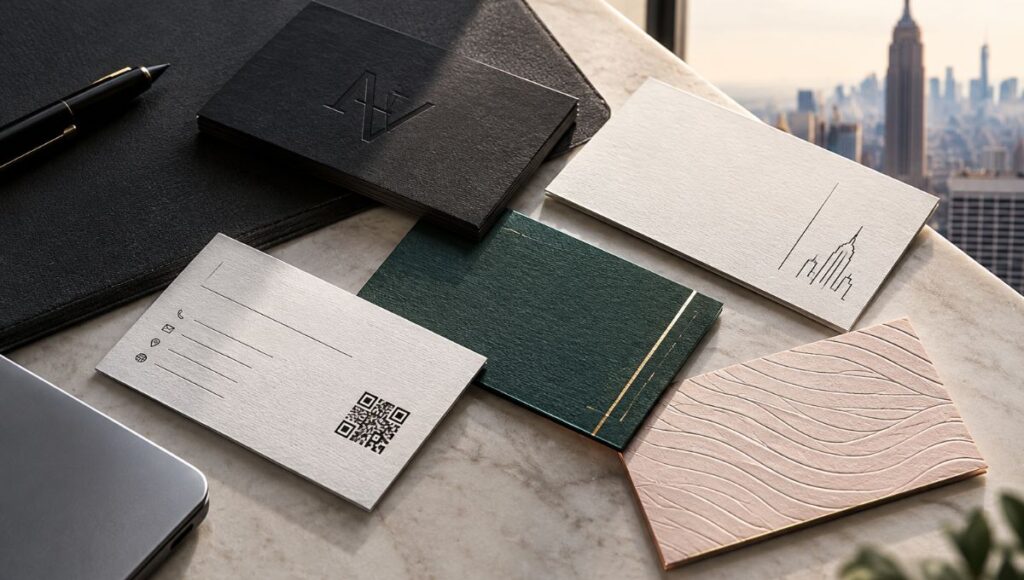
Luxury is not determined by one particular paper stock, color, or finishing process. Instead, a premium business card is usually the result of several design and production decisions working together. Paper, printing method, finishing, typography, color, and construction all influence how the finished card looks and feels. New York printers specializing in premium work commonly offer combinations such as thick stocks, cotton papers, foil stamping, embossing, letterpress, painted edges, and specialty coatings.
This is particularly important because luxury does not necessarily mean adding every available effect. A restrained card with a carefully selected stock and subtle blind embossing can communicate sophistication more effectively than a card covered with multiple decorative finishes. The goal should be coherence: every physical element needs to support the brand.
For example, a luxury business card might combine:
- A substantial, premium-weight paper stock.
- A restrained and sophisticated color palette.
- Carefully selected typography with appropriate hierarchy.
- Foil stamping for a logo or specific brand element.
- Embossing or debossing to introduce physical dimension.
- Letterpress printing for a tactile impression.
- Painted or colored edges to create a distinctive side profile.
- Minimal, intentional information rather than excessive content.
- A finish that complements the company’s broader stationery system.
The choice of paper is especially significant. Premium printers offer everything from smooth coated stocks to uncoated and cotton papers, while some business-card producers offer ultra-thick constructions and layered cards. Cotton paper is also frequently associated with tactile processes such as letterpress, foil, and embossing.
For businesses seeking luxury business cards nyc clients will remember, the best approach is therefore not to ask, “What is the most expensive finish?” Instead, ask, “Which combination of materials and techniques best expresses our brand?” That shift in thinking produces a more sophisticated result. A law firm, private investment company, luxury real estate agency, architect, fashion brand, restaurant, or creative studio may each require a completely different interpretation of luxury.
Premium Paper, Thickness, and Tactile Experience Matter
One of the clearest differences between conventional and luxury business cards is the physical experience of the card itself. Digital screens can reproduce colors, typography, photographs, and logos, but they cannot reproduce the actual weight, texture, pressure, or dimensionality of a physical piece of stationery. Premium printing takes advantage of those characteristics by making the card feel as considered as it looks.
Business-card printers in New York offer a wide range of materials, including matte, silk-laminated, cotton, and ultra-thick stocks. Some providers offer constructions ranging from approximately 20pt to 40pt, while other specialty printers create duplexed, triplexed, or even multi-layer cards.
Thickness can create an immediate sense of substance, but thickness alone does not guarantee a luxury result. The relationship between paper and design is more important. A minimalist logo printed on an elegant uncoated stock can feel premium without elaborate effects. Likewise, an extremely thick card can look poorly considered if its typography, spacing, or production quality is weak.
When selecting stock for a premium project, consider:
- Texture: Smooth, cotton, linen, and other tactile surfaces create different impressions.
- Weight and thickness: Heavier constructions can create a more substantial hand-feel.
- Color: White, warm white, black, colored, and specialty stocks can change how the entire identity is perceived.
- Printing compatibility: Some stocks are particularly suitable for processes such as letterpress or foil.
- Finish: Matte, soft-touch, laminated, or uncoated surfaces each communicate differently.
- Construction: Multiple layers can create colored cores or additional visual depth.
The printing technique should also be considered at this stage. Japan Printing, for example, offers letterpress business cards in NYC that use a traditional relief process to press inked plates into premium stock, creating a tactile impression. This illustrates why luxury printing should be planned as a complete production system rather than as a series of disconnected choices.
For businesses comparing nyc business card services, asking to see actual paper samples can be more useful than choosing based solely on photographs. Screens can suggest appearance, but physical samples allow you to evaluate thickness, texture, color, contrast, and finishing in your hands. That tactile evaluation is particularly important when investing in a premium identity system.
Foil, Embossing, Letterpress, and Other Finishes
Specialty finishing is one of the most effective ways to give luxury business cards a distinctive physical character. However, each technique creates a different result, and understanding those differences helps designers select finishes intentionally rather than simply adding effects because they look impressive in a digital mockup.
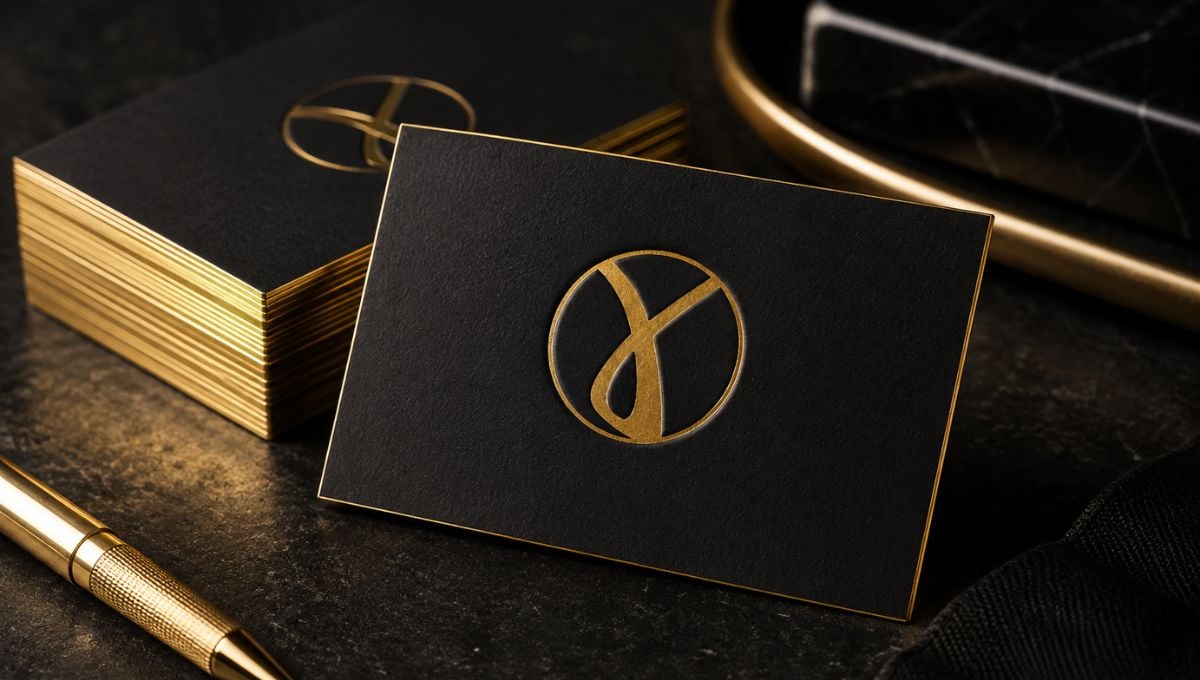
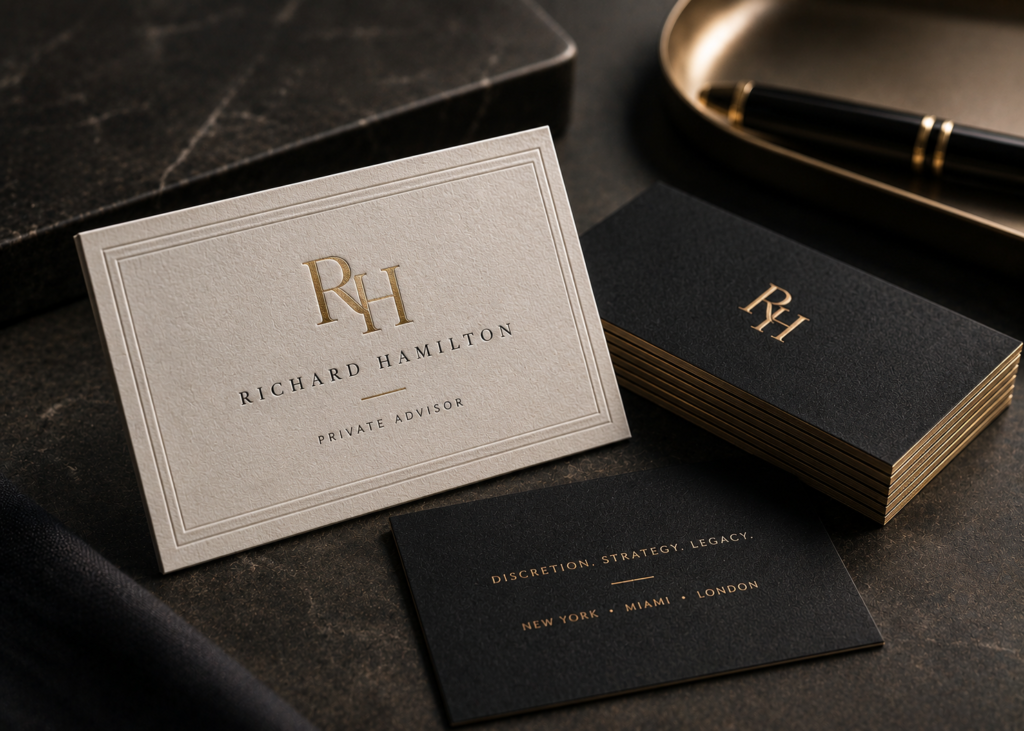
Foil stamping introduces a metallic or pigmented foil to selected areas of the card. Gold and silver are traditional choices, but specialty foils can create other visual effects. Foil can be particularly effective when used selectively on logos, names, borders, or small graphic elements rather than covering every available surface. Premium NYC printers offer foil options alongside other specialty processes.
Embossing and debossing create physical relief by changing the surface of the paper. Embossing raises an element above the surface, while debossing pushes it into the material. A blind emboss uses the paper itself without ink or foil, producing an understated tactile effect. Foil embossing can combine metallic or pigmented foil with dimensional relief.
Letterpress creates another tactile result. Rather than simply placing ink on top of the paper, the traditional process presses an inked plate into suitable stock, producing a characteristic impression. Japan Printing describes its letterpress process as particularly appropriate for simple layouts, spot colors, and refined brand aesthetics.
Other possible details include:
- Painted or colored edges.
- Die-cut shapes.
- Soft-touch or specialty coatings.
- Raised ink.
- Multi-layered card construction.
- Colored paper cores.
- Custom edge treatments.
- Combinations of digital printing with foil or letterpress.
These techniques can also be combined. Specialty printers demonstrate combinations such as letterpress plus foil stamping, digital printing plus specialty finishing, and die-cutting combined with letterpress or foil.
The key is restraint. If a brand uses gold foil, embossing, multiple colors, a complex die-cut shape, and an elaborate background simultaneously, none of the individual details may receive enough visual space to stand out. A stronger strategy might be a beautifully proportioned logo, premium stock, and one carefully selected tactile treatment.
That is why experienced nyc business card services should approach finishing as part of the design process rather than something added at the very end. For luxury business cards nyc brands can confidently use in important meetings, every production detail should contribute to the same visual message.
Designing Luxury Business Cards for Modern NYC Brands
The best luxury business card is not necessarily the most elaborate one. It is the one that translates the brand’s personality into a physical object with clarity and consistency. This is particularly relevant in New York, where business cards may be exchanged in environments ranging from corporate offices and real estate meetings to creative events, restaurants, conferences, galleries, and private networking gatherings.
A strong luxury card begins with hierarchy. The recipient should immediately understand the most important information: who you are, what company you represent, and how to contact you. Decorative details should never make essential information difficult to find. A sophisticated design can actually use fewer elements while giving each one more attention.
Typography is especially important. A premium card may use a serif typeface to communicate tradition and authority, a refined sans serif for contemporary sophistication, or a carefully paired combination of both. Spacing, alignment, scale, and margins can have as much influence on perceived quality as expensive finishing.
A useful design checklist includes:
- Keep the logo recognizable and appropriately sized.
- Establish a clear hierarchy between name, title, company, and contact details.
- Avoid overcrowding the card with unnecessary information.
- Choose typography that reflects the brand’s personality.
- Consider how the design works in both digital mockups and physical print.
- Select colors that remain consistent with the wider brand identity.
- Think about how foil, embossing, letterpress, or other finishes interact with the artwork.
- Check fine details and production specifications before approving the final file.
- Consider whether the card complements your letterhead, envelopes, folders, and other stationery.
Consistency is particularly important when business cards are part of a larger stationery system. A luxury card should not feel like an isolated promotional object. Ideally, its paper, typography, colors, logo treatment, and finishing language should connect naturally with the company’s other printed materials.
This is where professional design and production can make a meaningful difference. A printing company that understands both design and manufacturing can identify whether a concept is technically appropriate before production begins. For example, the visual effect of a fine line, small typeface, foil detail, or embossed element may depend heavily on the selected stock and production technique.
For companies searching for business cards in NYC, this integrated approach can be particularly valuable. Instead of treating design, paper selection, printing, and finishing as separate decisions, nyc business card services can bring them together into a unified production process. At Japan Printing, that philosophy allows brands to develop stationery that feels intentional from the first visual impression to the moment a recipient holds the card.
Conclusion
Luxury business cards are ultimately about more than thickness, metallic foil, or elaborate finishing. Their value comes from the relationship between design and physical production: the right paper, typography, color, printing process, tactile treatment, and information hierarchy working together to create a coherent brand experience. Whether the goal is understated elegance through letterpress and blind debossing or a more striking combination of foil, embossing, and premium stock, the strongest luxury business cards nyc brands use are those where every detail has a purpose. For companies looking for business cards in NYC, investing in thoughtful design and professional printing can turn a simple networking tool into a meaningful extension of the brand.
Ready to create a business card that represents your company at its best? Contact Japan Printing to request a quote for your custom business cards and stationery project. Our team can help you explore premium papers, specialty printing, and finishing options to develop a result aligned with your brand. If you are comparing nyc business card services or searching for luxury business cards nyc, let Japan Printing help you transform your concept into professionally designed and printed stationery.