Business Cards 09.11.26
Smart Print: How QR Codes and Print Are Creating Interactive Brand Experiences

Daniel Cantor
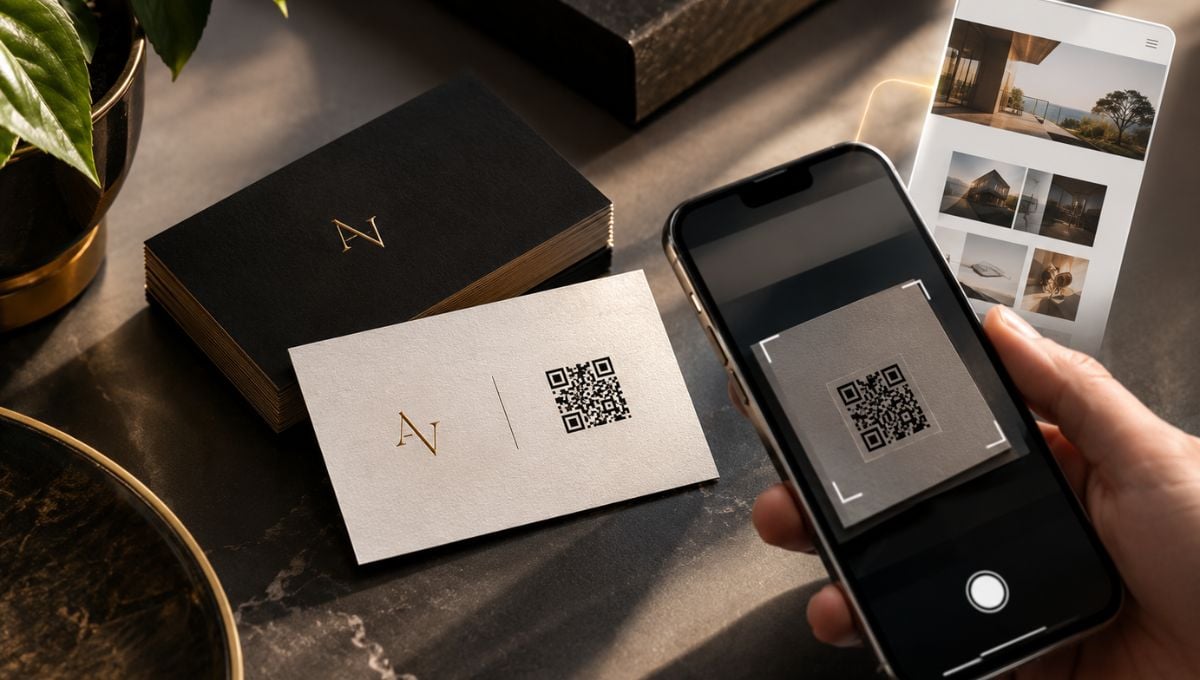
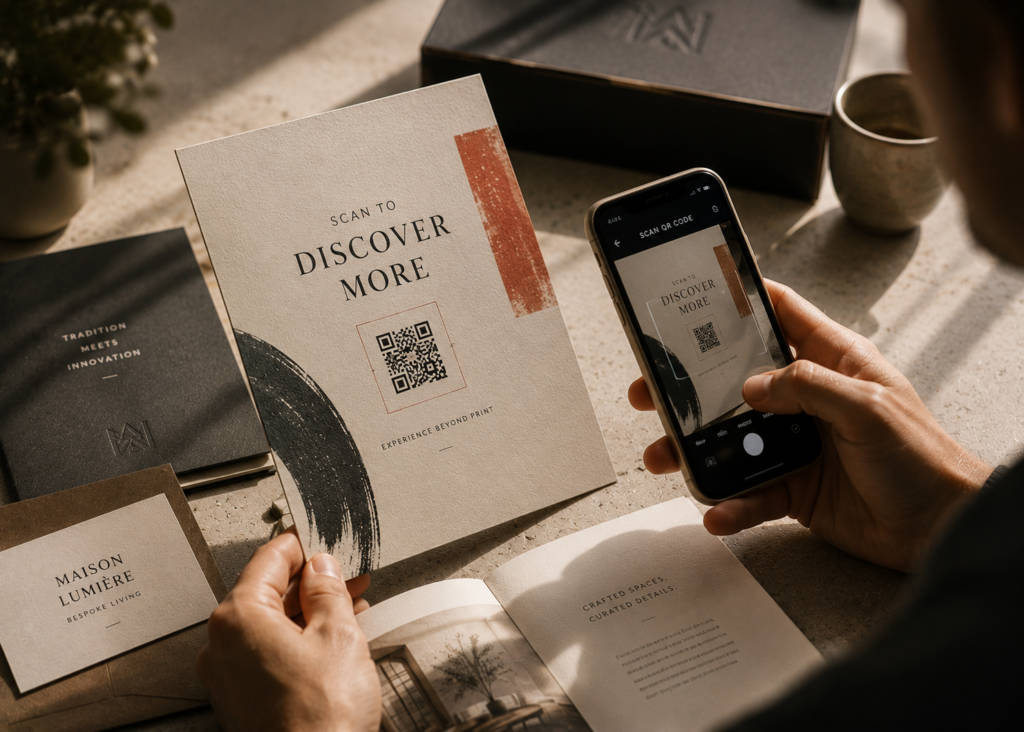
Print marketing is no longer limited to what customers can see, touch, and read on a physical surface. With QR codes, a business card, brochure, postcard, product package, or piece of stationery can become a gateway to digital content, creating a bridge between physical branding and online experiences. QR codes are particularly powerful because modern smartphones can generally scan them without requiring a dedicated app, allowing printed materials to connect customers with websites, videos, contact information, product details, promotions, reviews, social media, and other digital resources. GS1 is also promoting the broader adoption of 2D barcodes as the retail industry works toward its Sunrise 2027 goal, demonstrating how physical print and machine-readable digital information are increasingly becoming part of the same ecosystem.
For businesses investing in premium stationery and business cards in NYC, this creates an opportunity to make print more useful without sacrificing its visual impact. At Japan Printing, we help businesses turn ideas into professionally designed and printed materials that represent their brands. If you are planning a new identity, premium stationery, or luxury business cards nyc customers will remember, contact Japan Printing to request a quote for your business card design and printing project and discover how smart print can make your physical brand experience more interactive.
QR Codes Turn Static Print Into a Digital Gateway
Traditional printed materials have always had one major limitation: once they are printed, their content is essentially fixed. A business card can display a name, title, phone number, email address, website, and logo, but the physical card cannot change when a company’s information changes. QR codes introduce another layer of functionality. Instead of forcing every piece of information onto a limited physical surface, a printed design can invite the recipient to scan and continue the experience online.
This is particularly useful for business cards. A thoughtfully designed QR code could direct someone to a digital portfolio, company website, appointment page, LinkedIn profile, contact form, product catalog, or landing page. The printed card remains valuable as a tangible introduction, while the QR code provides a pathway to significantly more information.
The same principle can apply to other printed materials:
Business cards: Link to portfolios, contact pages, booking systems, or professional profiles.
Postcards: Send recipients to promotions, special offers, or campaign landing pages.
Brochures: Connect printed information with product demonstrations, videos, or additional specifications.
Packaging: Provide product information, instructions, sustainability information, or authentication resources.
Stationery: Direct customers toward websites, ordering portals, digital catalogs, or brand content.
Event materials: Connect attendees with registration pages, schedules, presentations, or follow-up resources.
GS1 specifically describes QR codes with GS1 Digital Link as a way to connect consumers directly with brands while simultaneously supporting other business processes. Modern QR codes can also connect physical products to online information such as ingredients, product images, videos, reviews, and recycling information.
For nyc business card services, this means a QR code should not simply be treated as a decorative square added at the end of a design. It should be considered part of the information architecture. The designer needs to determine what happens after the scan and how that digital destination complements the printed experience.
The strongest smart-print projects therefore treat the QR code as a bridge—not the destination itself. The physical piece creates the first impression, while the digital experience continues the conversation.
Smart Print Makes Premium Business Cards More Functional
Luxury printing has traditionally focused on qualities such as paper thickness, texture, finishes, typography, color, embossing, foil stamping, and carefully constructed layouts. Those elements remain important because physical materials communicate qualities that digital screens cannot fully reproduce. A beautifully produced business card can establish credibility before a conversation even begins.
QR technology does not replace those characteristics. Instead, it can make premium print more functional.
Consider a luxury real estate agent, architect, photographer, attorney, consultant, fashion professional, or creative director. Their business card might contain only essential information because excessive text would weaken the design. Rather than filling the card with every service, social profile, portfolio link, and contact option, a QR code can provide access to the broader digital ecosystem.
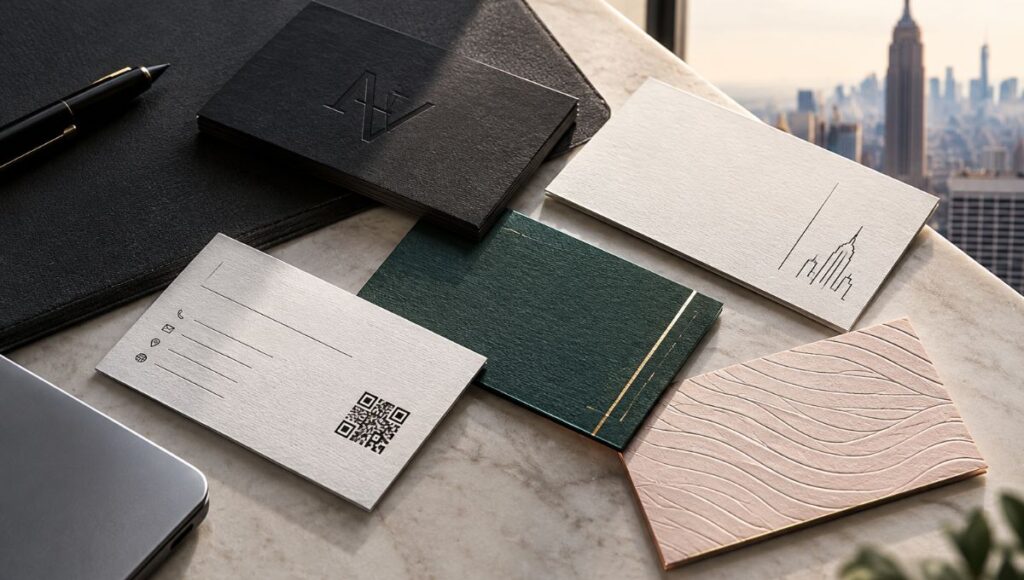
This approach can be especially effective for luxury business cards nyc because premium design often depends on restraint. A minimal card with sophisticated typography, substantial stock, and a discreet QR code can communicate far more than a crowded card attempting to contain everything.
A smart business card might provide access to:
A digital portfolio showcasing recent projects.
A professional biography introducing the individual or company.
A scheduling page for consultations or appointments.
A digital contact card that makes saving contact information easier.
Social media profiles for continued brand interaction.
A promotional landing page created specifically for a campaign or event.
A product or service catalog that would be impractical to print on the card itself.
This creates an important relationship between physical design and digital strategy. The printed card communicates identity, while the QR code expands functionality.
There is also a broader industry shift supporting this philosophy. GS1’s Sunrise 2027 initiative is encouraging the retail industry to move toward 2D barcodes capable of carrying substantially more information than traditional 1D barcodes. The objective is not simply to replace one visual symbol with another; it is to create richer connections between physical products, digital information, consumers, retailers, and supply chains.
For designers and printers, this signals a broader change: print is increasingly becoming an interface. The physical material still matters, but its role can extend beyond communication on paper.
The Best QR Experiences Begin With Good Print Design
Adding a QR code to a printed piece does not automatically make it interactive or effective. The code still needs to be integrated into the design in a way that preserves readability, usability, and visual hierarchy.
A QR code that is too small, poorly positioned, low-contrast, distorted, or surrounded by competing visual elements may create unnecessary friction. GS1’s guidance emphasizes that 2D barcodes need to be appropriately printed, positioned, scanned, and verified if they are going to function reliably within the broader ecosystem.
For designers working on smart print, several principles are particularly important:
Preserve sufficient contrast. The QR code needs to remain visually distinguishable from its background.
Give the code breathing room. A clear area around the code helps scanning reliability.
Avoid unnecessary distortion. The code should not be stretched or altered in ways that interfere with its structure.
Test the final printed piece. A QR code that works on a computer screen is not necessarily guaranteed to work equally well after printing.
Consider the material. Paper texture, coatings, finishes, curvature, and other physical characteristics can affect the final result.
Provide context. A short call-to-action such as “Scan to view portfolio” can tell the recipient why scanning is worthwhile.
Design for the destination. The webpage or digital experience should work properly on a smartphone.
The final point is especially important. A QR code can create the connection, but the destination determines whether the experience succeeds.
Imagine receiving a beautifully printed business card from a high-end New York firm. You scan the QR code and land on a desktop-only website with tiny text, slow loading, outdated information, and no obvious way to contact the company. The printing may have been excellent, but the interactive experience feels unfinished.
Conversely, a well-designed card can create a seamless sequence:
Physical card → QR scan → mobile landing page → useful information → contact or conversion.
This is where nyc business card services can evolve beyond conventional printing. Instead of thinking exclusively about paper and ink, designers can consider how the printed object functions as the first step in a broader customer journey.
The QR code should also have a reason to exist. If the only destination is the same phone number and email address already printed on the card, its usefulness may be limited. The best implementations give recipients something additional—information, convenience, exclusive content, visual work, an offer, or another meaningful reason to continue interacting with the brand.
From Business Cards to Packaging, Smart Print Is Becoming a Brand Strategy
The potential of QR-enabled print extends far beyond business cards. As brands increasingly look for ways to combine physical experiences with digital information, QR codes can become part of a broader strategy for making printed materials more useful and measurable.
GS1’s current work around 2D barcodes illustrates the scale of this transition. Its Sunrise 2027 initiative aims for retail point-of-sale systems globally to be capable of processing 2D barcodes alongside existing linear barcodes by the end of 2027. Importantly, this does not mean traditional barcodes instantly disappear; the transition is expected to be gradual, with both formats coexisting during the migration.
GS1 US also reports findings from its 2025 consumer research indicating that 79% of surveyed consumers were more likely to purchase products with a scannable QR code providing additional product information, while 77% considered product information important when making a purchase. The research also found that 62% said they would be willing to spend more on a product offering detailed information.
These numbers help illustrate why smart print is becoming more than a novelty. Consumers can use a physical package or printed piece as an entry point to additional information.
For brands, potential applications include:
Product packaging: connect customers to instructions, ingredients, product stories, reviews, or sustainability information.
Restaurant menus: provide updated menus, ordering pages, promotions, or nutritional information.
Retail displays: connect physical displays to product demonstrations or online shopping.
Direct mail: create a bridge between printed campaigns and digital landing pages.
Event invitations: provide RSVP pages, maps, schedules, or event information.
Corporate stationery: connect recipients with company resources and digital profiles.
Business cards: create a more comprehensive digital introduction without overcrowding the printed card.
For premium brands, the key is maintaining the physical experience while adding digital functionality. A QR code should complement the visual identity rather than dominate it.
This is particularly relevant in a market such as New York, where competition for attention is intense and a business card needs to accomplish more than simply display contact information. A beautifully printed card can make the initial impression; a well-planned QR experience can give that impression somewhere to go.
That combination represents the real opportunity behind smart print: physical design creates recognition, while digital connectivity creates continuation.
Conclusion
QR codes are helping redefine what printed materials can do. A business card no longer has to be limited to the information physically printed on its surface, and packaging, postcards, brochures, and stationery can become gateways to digital experiences. As the industry moves toward increasingly capable 2D barcode systems, the relationship between physical print and digital information is becoming more sophisticated.
For brands investing in business cards in NYC, this is an opportunity to combine premium materials and design with practical digital functionality. Whether you are looking for luxury business cards nyc, developing a new stationery system, or need professional nyc business card services, Japan Printing can help bring the physical side of your brand to life. Request a quote for your business card design and creation project with Japan Printing today and turn your next printed piece into a smarter brand experience.