Business Cards 09.30.26
Standard vs Premium Business Cards: Which Option Is Right for Your Brand?

Daniel Cantor
Business cards remain an important physical touchpoint between a company and its customers, partners, and prospects. While digital networking has made it easier to exchange contact information, a professionally printed card can still provide something a digital profile cannot: a physical representation of your brand that people can see, hold, and keep. When choosing between standard and premium business cards, the decision is not simply about choosing the more expensive option. A well-designed standard card can communicate professionalism effectively, while premium materials and specialty finishes can add texture, weight, and visual distinction. The right choice depends on your industry, brand identity, networking habits, quantity, and budget.
For businesses looking for business cards in NYC, understanding the differences between these options can make the printing process much easier. Whether you need practical cards for everyday networking or distinctive materials for a luxury-oriented brand, Japan Printing can help you design and create business cards around your specific goals. Contact Japan Printing to request a quote for your business card design and printing project.
What Is the Difference Between Standard and Premium Business Cards?
The primary difference between standard and premium business cards is not necessarily the quality of the design. Instead, it generally comes down to the physical materials, construction, finishes, and production techniques used to create the finished card. As PrintShaq explains, a strong design can work effectively on standard stock, while premium printing introduces additional physical characteristics such as increased thickness, specialty coatings, embossing, foil, and other finishing options.
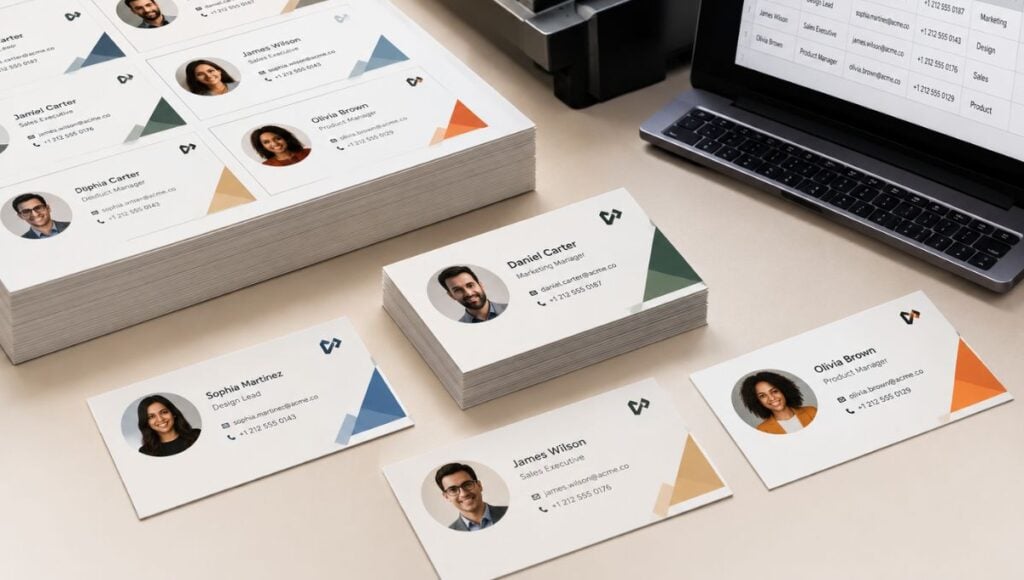
Standard business cards are designed to provide a practical and professional solution without requiring extensive specialty production. They may use conventional cardstock with a standard matte, glossy, or uncoated finish. This makes them particularly useful for professionals and businesses that distribute large quantities of cards regularly.
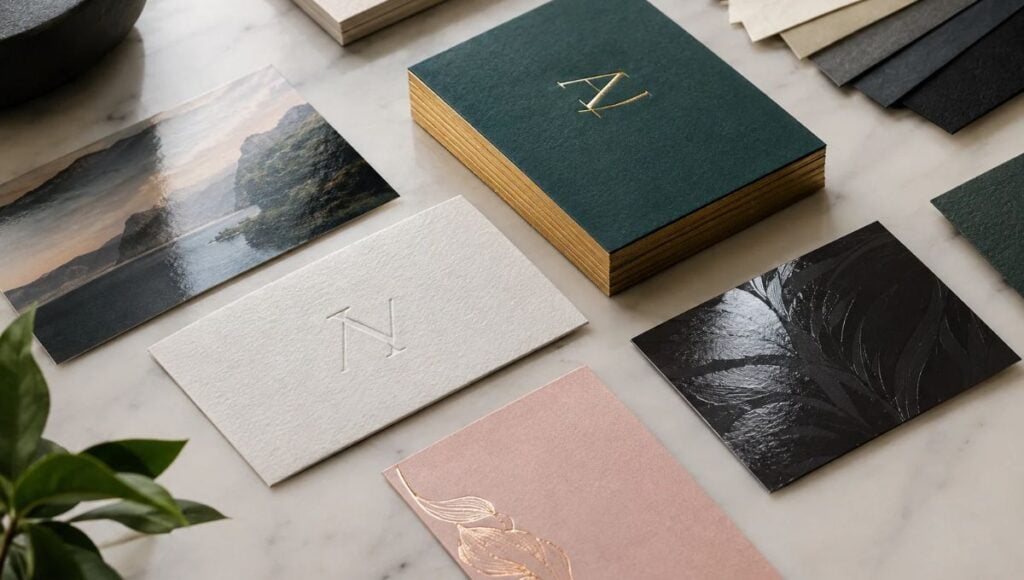
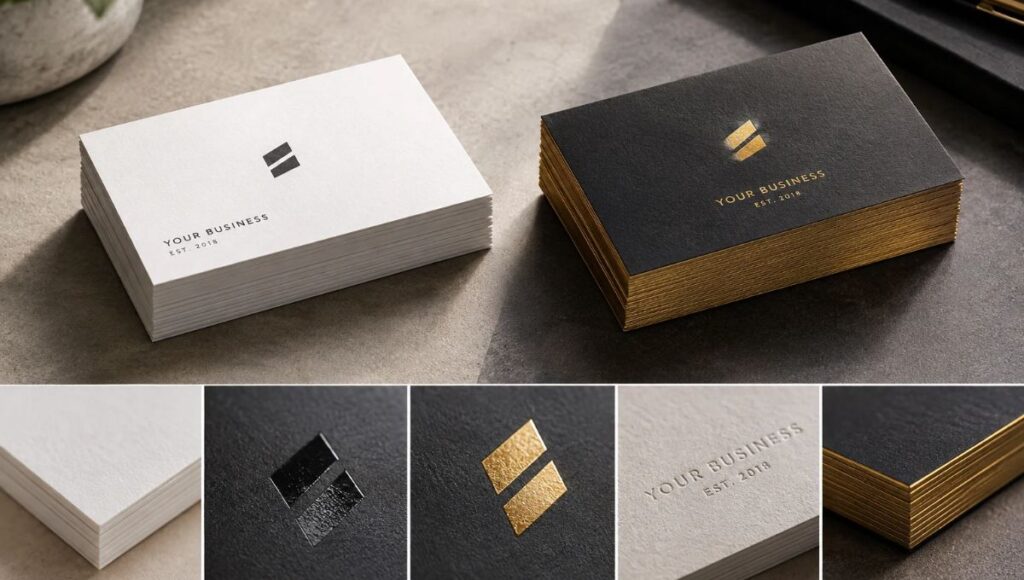
Premium business cards, by contrast, can incorporate additional features designed to create a distinctive tactile and visual experience. Depending on the printer and available production methods, premium options may include:
- Heavier or thicker cardstock
- Multi-layer card construction
- Soft-touch or suede-style coatings
- Matte or specialty laminations
- Spot UV
- Foil stamping
- Embossing or debossing
- Painted or colored edges
- Specialty paper stocks
- Unusual textures or materials
- Die-cut shapes
PrintShaQ specifically identifies thicker stocks, specialty coatings, embossing, foil stamping, painted edges, and other construction choices as characteristics commonly associated with premium business cards.
However, premium does not automatically mean better for every company. A business that distributes thousands of cards at conferences may benefit more from a practical, well-designed standard card than from an elaborate card with several specialty finishes. Conversely, a luxury interior designer, real-estate professional, attorney, creative agency, or high-end hospitality company may want the physical card to reinforce a more sophisticated brand identity.
The important point is that the card should support the brand rather than simply add expensive features. A premium finish cannot compensate for poor typography, confusing information hierarchy, weak branding, or an overcrowded layout. The design still needs to work first.
How Paper Weight and Finishes Affect the Business Card Experience
Paper stock is one of the most noticeable differences between standard and premium business cards because recipients can physically feel it. Cardstock can be described using different measurement systems depending on the market, including GSM and points (pt). GSM refers to grams per square metre, while point measurements commonly describe thickness in North American printing. These measurements are related to the physical characteristics of paper but should not be treated as directly interchangeable because they measure different properties.
Many professional business cards fall within a range of approximately 300–400 GSM, although available specifications vary by printer and paper type. Some premium cards use considerably heavier or thicker constructions. Recent printing guides also distinguish between standard stocks and heavier options designed to create greater rigidity and presence.
The finish is another important consideration. A finish can influence both appearance and tactile perception:
- Matte: Reduces surface reflection and creates a smooth, understated appearance.
- Gloss: Produces a more reflective surface and can emphasize colorful or image-heavy designs.
- Uncoated: Provides a more natural paper texture and can be useful when a traditional or tactile appearance is desired.
- Soft-touch: Adds a smooth, velvety surface that changes the way the card feels in the hand.
- Spot UV: Adds a localized glossy effect to selected areas, such as a logo or graphic.
- Foil stamping: Applies a metallic or specialty foil effect to selected elements.
- Embossing: Raises selected areas of the design to create a three-dimensional tactile effect.
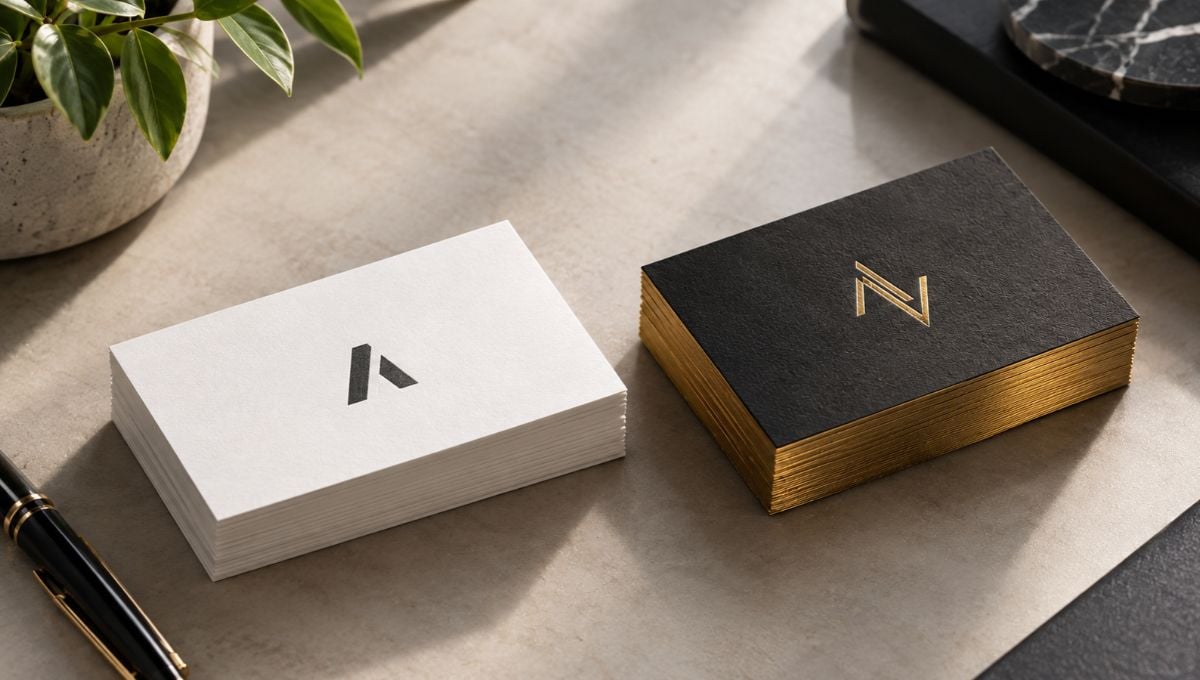
The choice should depend on the visual identity and practical use of the card. For example, a minimalist consulting firm may prefer a thick matte card with restrained typography, while a luxury brand may use dark stock, foil, and embossing to create a more dramatic physical experience.
Importantly, adding more features is not necessarily the objective. The goal is to select the combination of stock and finish that reinforces the brand. A carefully chosen 350–400 GSM stock with an appropriate finish can be more effective for a particular company than an extremely thick card covered with multiple effects. Current printing guidance similarly emphasizes that the best stock depends on the project, printing method, desired appearance, and intended use.
When Should Your Brand Choose Standard Business Cards?
Standard business cards can be an excellent choice for companies that prioritize practicality, consistency, and efficient production. Choosing a standard option does not mean compromising on professionalism. In fact, as PrintShaQ points out, a well-designed standard business card can be just as visually effective as a premium card when typography, spacing, branding, and printing are handled properly.
One of the biggest advantages of standard cards is that they can be easier to produce in larger quantities. This matters for businesses whose employees attend conferences, trade shows, networking events, sales meetings, or community events where dozens or hundreds of cards may be distributed.
Standard cards may also make sense when the physical card is primarily intended to communicate essential information rather than serve as a major brand statement.
A standard business card can be particularly appropriate when:
- You distribute cards frequently.
- You need a larger quantity for employees or sales teams.
- Your budget prioritizes volume.
- Your brand identity is clean and minimalist.
- Your customers expect a conventional professional card.
- The card is primarily being used to exchange contact information.
- You frequently update phone numbers, addresses, employees, or other information.
- You want to keep production relatively straightforward.
- You prefer a classic rather than highly tactile appearance.
For example, a growing service business might need several thousand cards for employees across different departments. Spending significantly more on specialty finishes for every card may not provide enough additional value to justify the increased production cost.
Standard cards can also be a strong option for businesses that want their design to communicate confidence through simplicity. A clean logo, appropriate typography, strong contrast, balanced spacing, and a suitable paper stock can create a polished result without requiring foil, embossing, or unusually thick construction.
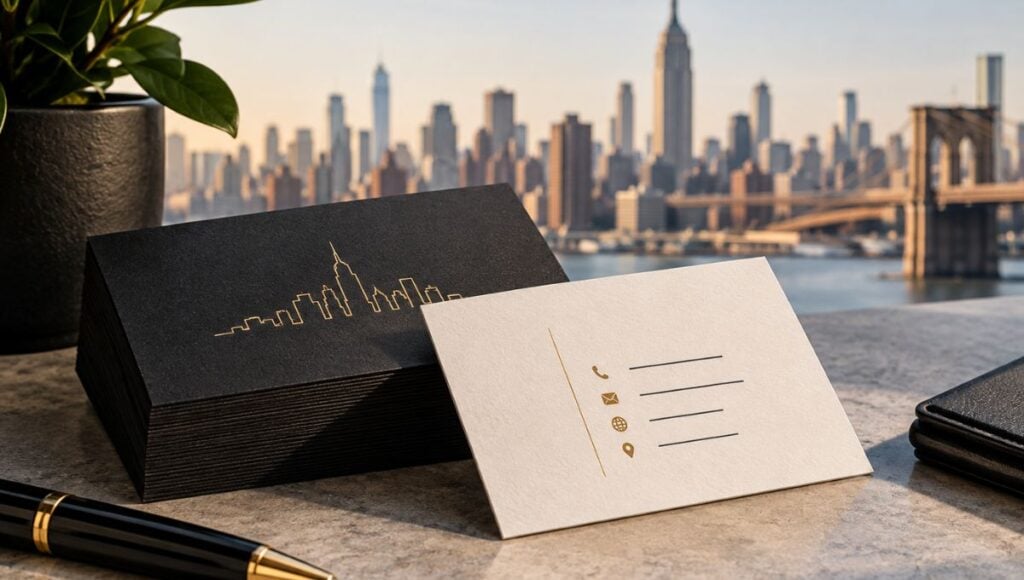
For companies searching for business cards in NYC, the same principle applies: the right card is the one that matches the actual purpose of the project. If you need reliable, professional cards for everyday networking, a standard specification may provide the balance of appearance, functionality, quantity, and budget that your business requires.
When Are Premium Business Cards Worth Considering?
Premium business cards become particularly relevant when the physical experience of receiving the card is an important part of the brand. They can provide additional opportunities to differentiate a business through material, texture, thickness, color, and specialty finishing.
The concept of premium printing is not limited to making a card thicker. PrintShaQ notes that premium characteristics can include soft-touch coatings, spot UV, embossing, debossing, foil stamping, painted edges, multi-layer construction, and increased rigidity. Amana Printing similarly focuses on premium printing as a way for businesses to create higher-quality physical brand materials.
Premium business cards may be worth considering when your brand operates in an industry where presentation and physical details are particularly important. Examples can include:
- Luxury real estate
- Interior design
- Architecture
- High-end hospitality
- Fashion
- Photography
- Creative agencies
- Professional services
- Premium construction and development
- Jewelry and luxury retail
- Executive-level consulting
For these businesses, the card may function as more than a contact-information tool. It can become a small physical extension of the brand.
For example, an architect could choose an understated thick stock with blind embossing, while a luxury real-estate professional might choose a dark matte card with metallic foil. A creative agency could use an unusual shape or tactile coating to demonstrate its approach to design.
That does not mean every premium business card needs multiple effects. In many cases, restraint can make the result more sophisticated. One carefully selected specialty treatment may create more visual impact than combining foil, embossing, spot UV, unusual shapes, and multiple colors without a clear purpose.
If you are researching premium business cards NYC options, consider the entire project rather than focusing only on the price of the finished cards. Think about where you will distribute them, who will receive them, how the card reflects your existing brand identity, and whether the additional physical features contribute to the experience you want to create.
Premium printing can therefore be most useful when the physical card itself is part of the brand experience. The objective is not simply to make the card more expensive; it is to make the material choices meaningful.
Conclusion
There is no universal answer to whether standard or premium business cards are right for every company. Standard cards can provide a professional, practical solution for businesses that distribute cards frequently or need to manage printing costs and quantities efficiently. Premium cards provide additional opportunities to differentiate a brand through heavier stocks, specialty textures, coatings, foil, embossing, and other finishing techniques. The best specification depends on how the card will be used, what the brand communicates, and which physical details genuinely support that identity.
Whether you are looking for straightforward business cards in NYC or exploring premium business cards NYC options, Japan Printing can help you turn your branding into professionally designed and printed stationery. Request a quote from Japan Printing for your business card design and creation project, and work with a printing partner to select the right paper, finish, format, and production approach for your brand.