Stationery 07.17.26
The Ultimate Guide to Paper Weights and Their Equivalents (pt, gsm, lb)

Daniel Cantor

Choosing the right paper is one of the most important decisions in any printing project. While many people focus solely on the design, the thickness, weight, and rigidity of the paper have a direct impact on perceived quality, durability, and the overall experience of handling a printed product. This is especially important for business cards, corporate stationery, invitations, and premium marketing materials.
One of the most common sources of confusion, however, is the existence of different measurement systems. Some manufacturers use gsm (grams per square meter), while others rely on lb (basis weight) or pt (points or thousandths of an inch) to describe paper or cardstock. Understanding these equivalents makes it much easier to compare materials from different countries and make informed decisions before sending a project to print.
At Japan Printing, we work daily with clients looking for premium business cards in NYC, helping them select the ideal paper based on their budget, brand identity, and specific project requirements. If you’re planning a new print project, our team can guide you in choosing the perfect paper to achieve professional results from the very first impression.
What Do pt, gsm, and lb Mean?
Although these three systems are commonly used to describe paper quality or thickness, each one actually measures a different characteristic.
GSM (Grams per Square Meter)
The GSM system measures the weight of one square meter of paper. It is the most widely used international standard and arguably the easiest system for comparing paper stocks.
Some common examples include:
- 80 gsm: Office paper
- 100–120 gsm: Brochure paper
- 150–170 gsm: Premium flyers
- 250–300 gsm: Standard business cards
- 350–450 gsm: Premium business cards and luxury stationery
A higher GSM generally indicates a thicker and more rigid paper, although this also depends on the fiber composition and manufacturing process.
LB (Basis Weight)
The lb (basis weight) system measures the weight of a specific number of sheets in the paper’s standard base size, which varies depending on the paper category (bond, cover, text, index, and others).
For example:
- 80 lb Text is not the same as 80 lb Cover.
- Two papers with the same pound rating may have completely different thicknesses.
- This system is widely used throughout the United States.
For this reason, comparing international paper stocks using only the pound rating can be confusing unless the paper category is clearly specified.
PT (Points)
Points (pt) measure the physical thickness of paper or cardstock.
One point equals approximately:
- 0.001 inch
- 0.0254 mm
Common cardstock thicknesses include:
- 12 pt
- 14 pt
- 16 pt
- 18 pt
- 24 pt
- 32 pt
The higher the point value, the thicker the material.
This measurement system is especially popular within the U.S. business card industry and is often the primary reference used by providers of nyc business card services and luxury business cards nyc, since it more accurately reflects the finished product’s physical feel.
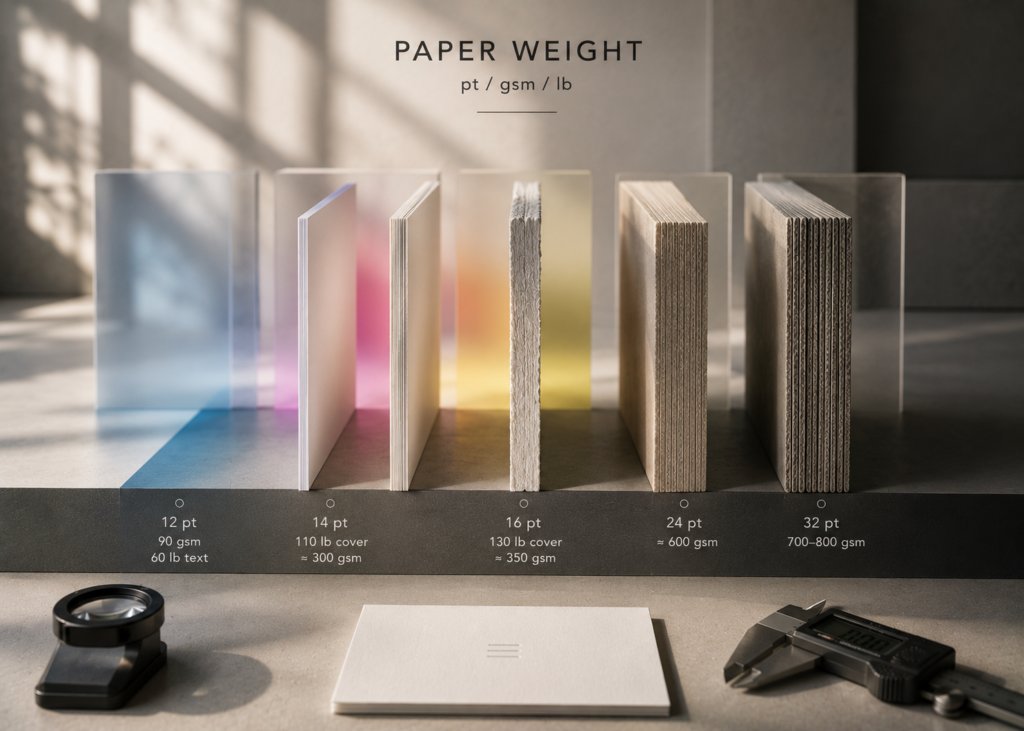
Approximate Equivalents Between pt, gsm, and lb
There is no exact mathematical conversion between these three systems because paper thickness also depends on fiber composition, manufacturing methods, coatings, and finishing processes.
However, the printing industry recognizes several approximate equivalents that serve as useful reference points.
Approximate Thickness
10 pt
12 pt
14 pt
16 pt
18 pt
24 pt
32 pt
Approximate GSM
200–220 gsm
250–270 gsm
300 gsm
350 gsm
400 gsm
Approx. 600 gsm
700–800 gsm
Cover Weight
80 lb Cover
100 lb Cover
110 lb Cover
130 lb Cover
140 lb Cover
Multi-layer laminated stock
Triple-layer stock
These figures are only approximations because every manufacturer produces paper with different densities.
For example, cotton paper is generally thicker than coated paper with the same GSM. Likewise, recycled paper may have a different thickness than paper made from virgin pulp, even if both share the same weight.
Additionally, finishing processes such as:
- Soft-touch lamination
- Matte lamination
- Gloss lamination
- Duplex mounting
- Triple-layer construction
- Multi-layer mounting
can significantly increase the final thickness without necessarily changing the original GSM of each individual sheet.
This is why suppliers specializing in luxury business cards nyc typically specify both the point thickness and the material construction to eliminate confusion during production.
What Paper Weight Is Best for Each Type of Project?
Selecting the right paper depends on the intended use, budget, and the image a company wants to project.
Below are some common recommendations used throughout the professional printing industry.
Everyday Documents
- 75–90 gsm
- Office paper
- Internal printing
- Photocopies
Flyers and Handouts
- 130–170 gsm
- Good rigidity
- Excellent print quality
- Easy to distribute
Corporate Brochures
- 170–250 gsm
- More elegant appearance
- Increased durability
Postcards
- 250–350 gsm
- Excellent durability
- Premium feel
Standard Business Cards
- 300–350 gsm
- Approximately 14–16 pt
- Widely used across many industries
Premium Business Cards
- 400 gsm or higher
- 18 pt or thicker
- Specialty laminations
- Soft-touch finish
- Metallic finishes
- Foil stamping
- Letterpress
- Spot UV coating
In the U.S. market, many companies prefer 16 pt or even 32 pt cardstock when they want to communicate exclusivity and premium quality.
It’s no coincidence that providers specializing in nyc business card services frequently recommend heavier stocks for architects, attorneys, consultants, real estate professionals, and luxury brands, where first impressions play a critical role.
How to Choose the Right Paper Quality for Your Business Cards
A great business card depends on far more than attractive graphic design. The paper itself is one of the most influential factors in communicating professionalism and quality.
Before selecting a paper stock, it’s worth considering several important factors.
1. Brand Identity
A technology company may prefer a minimalist matte finish, while a luxury brand might choose multi-layer cardstock, cotton paper, or metallic finishes.
2. Durability
If your business cards will be handed out frequently during meetings, networking events, or trade shows, thicker and more durable materials are generally the better choice.
3. Finish
The same paper can create dramatically different impressions depending on the finish applied.
Popular finishing options include:
- Soft Touch
- Matte
- Gloss
- Satin
- Spot UV
- Gold Foil
- Silver Foil
- Letterpress
- Edge Painting
- Embossing
4. Compatibility with Specialty Printing Techniques
Certain paper stocks perform better with specific printing methods, including:
- Hot Foil Stamping
- Letterpress
- Embossing
- Screen Printing
- Offset Printing
- Digital Printing
5. Budget
The thickest paper isn’t always the best solution. In many cases, combining an appropriate paper weight with premium finishes provides the ideal balance between cost and perceived quality.
Professionals specializing in luxury business cards nyc typically evaluate all of these factors before recommending a specific material, ensuring that every business card accurately represents the client’s brand and meets the expectations of its recipients.
Conclusion
Understanding the differences between pt, gsm, and lb makes it much easier to choose the right paper for any printing project. Although each system measures a different characteristic, knowing their approximate equivalents helps compare materials manufactured in different countries and minimizes production errors.
When it comes to business cards, selecting the appropriate thickness, combining it with premium finishes, and choosing materials that align with your brand identity can make a significant difference in how your business is perceived. Whether you’re looking for standard materials or premium solutions for business cards in NYC, partnering with an experienced printing provider ensures superior results and a more reliable printing experience.
At Japan Printing, we provide personalized guidance to help you select the ideal paper, finishes, and printing techniques for your project. If you’re looking for nyc business card services or want to create luxury business cards nyc with exceptional quality, contact us today for a quote. Our team will be happy to help you create business cards and corporate stationery that represent your brand at the highest standard.