Business Cards 08.05.26
Ultra-Thick Business Cards: Benefits, Types, and When to Use Them

Daniel Cantor
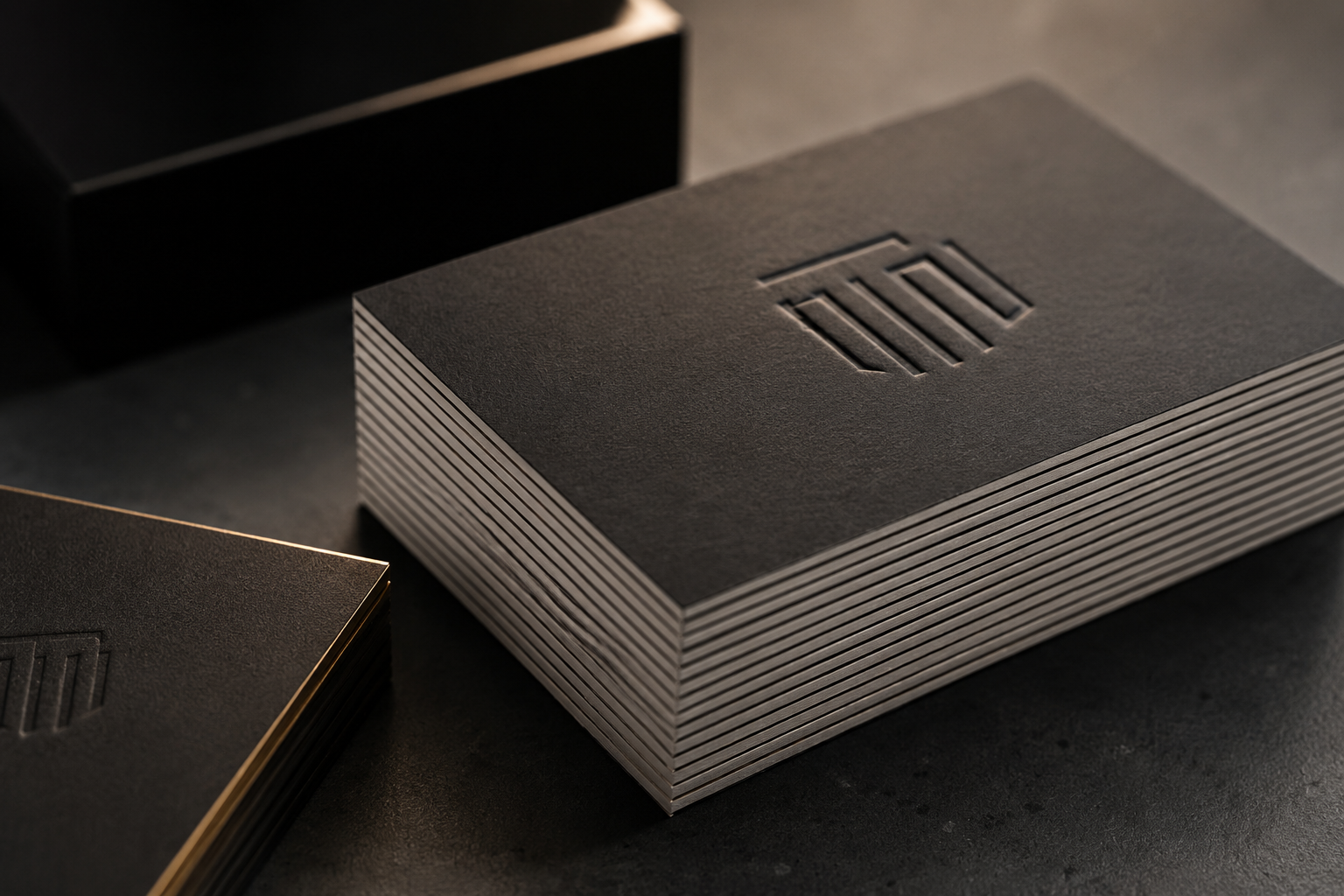
A business card doesn’t have to be oversized or covered in effects to make an impression. In many cases, the impact begins with something much more basic: what a person feels when they receive the card in their hands. Ultra-thick business cards take this idea to the next level through high-thickness stocks, multi-layer constructions, and especially rigid materials that transform a traditional networking piece into a tangible element of brand identity. While a conventional business card may typically be around 14–19 pt, premium options are available in 28, 32, 35, 38 pt, and even higher. For example, MOO offers a 32 pt, 600 gsm Luxe stock, while other specialized providers work with 38 pt alternatives.
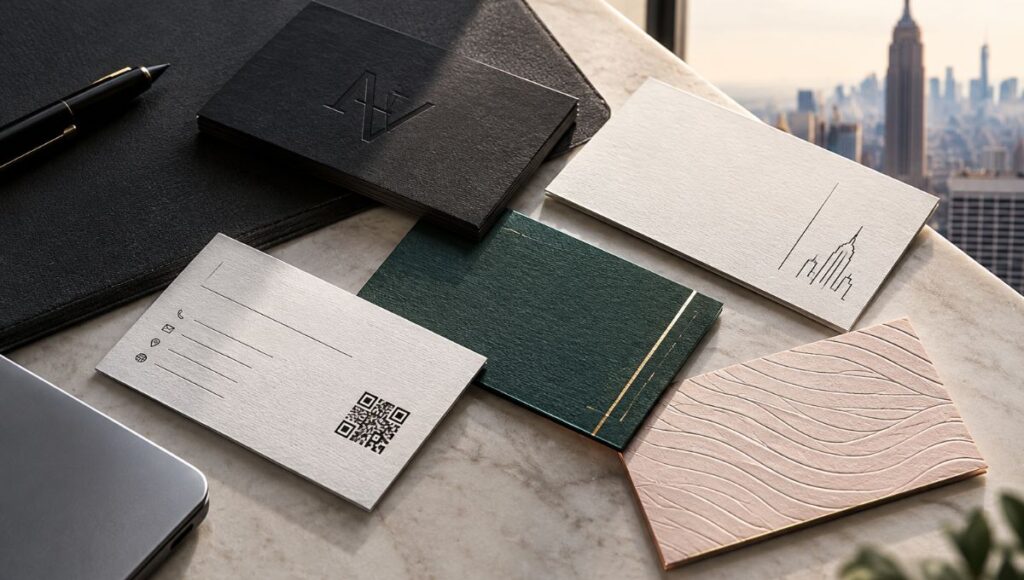
For businesses looking to stand out in competitive markets, this feature can complement a sophisticated visual identity. It is especially relevant for luxury business cards nyc, professional firms, and brands that want their stationery to communicate quality from the very first interaction. If you’re looking to develop your own cards, you can request a quote for your business card design and production project with Japan Printing and explore options that fit your brand and budget.
What Exactly Are Ultra-Thick Business Cards?
The term “ultra-thick” does not correspond to a single universal standard, but in the printing industry it is generally used to describe cards that clearly exceed the typical thicknesses of standard business cards. To put this into perspective, Avery lists business cards ranging from 12 to 15.6 pt in some of its product lines, while MOO places its standard options at 16–19 pt and its Luxe line at 32 pt.
Thickness can be achieved through an especially heavy paper stock or, very commonly in premium products, by bonding multiple layers of paper together. A 32 pt card, for example, can be constructed using laminated or adhered layers. MOO describes its Luxe cards as 32 pt cards made from multiple layers of Mohawk Superfine paper, while other printers offer two- or three-layer constructions to reach thicknesses of 28, 32, or 38 pt.
It is important to distinguish between several concepts:
- Thickness (pt): indicates the physical thickness of the material.
- Paper weight (gsm): indicates the weight of the paper per square meter.
- Construction: determines whether the card is made from a single piece or multiple layers.
- Finish: may be matte, glossy, uncoated, soft touch, or another treatment.
- Edge: may remain white, reveal a colored core, or incorporate a special treatment.
Therefore, saying that a card is “600 gsm” does not automatically mean that all 600 gsm cards have exactly the same thickness. The material, manufacturing process, and construction all influence the final result. For business cards in NYC projects, this distinction is particularly important because it allows you to choose the material according to the effect you actually want to achieve, rather than simply choosing the highest number.
In other words, an ultra-thick business card is not simply “more paper”: it is a combination of structure, tactile feel, rigidity, finish, and design.
Benefits: More Presence, Durability, and Creative Possibilities
The main benefit of increasing a business card’s thickness is the physical experience. A 32 pt card feels considerably different from a 16 pt card, and that difference can become part of the brand experience. MOO, for example, describes its 32 pt Luxe paper as an option designed for maximum thickness, weight, texture, and a strong first impression.
Rigidity can also help the card maintain its shape better during handling and storage. Manufacturers of ultra-thick cards specifically highlight qualities such as resistance to bending and increased rigidity.
Some of the main benefits include:
- Greater tactile impact: the card is immediately perceived as different from a conventional business card.
- Greater rigidity: thick stocks are less flexible and can provide a more solid feel.
- Visual differentiation: thick edges can become a design element.
- Greater aesthetic freedom: some materials allow you to combine thickness with colored cores, textures, or special finishes.
- Premium feel: the material can complement a high-end visual identity.
- More branding opportunities: the edge of the card can become a deliberate part of the visual system.
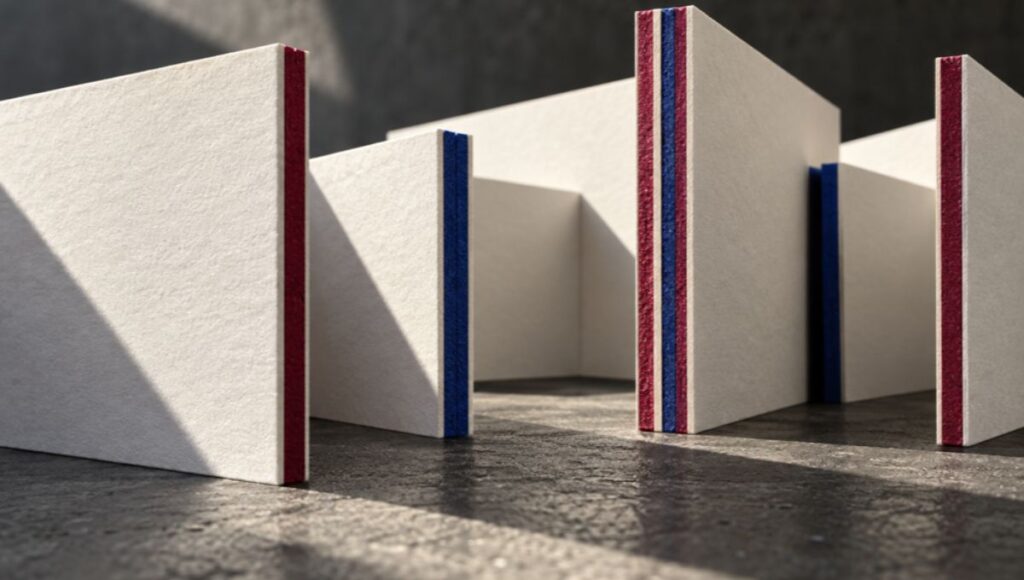
This last feature is particularly interesting. Some ultra-thick cards use a colored core or “seam” that becomes visible between the layers. MOO, for example, offers eight different colors for the center edge of its 32 pt Luxe cards, while other printers offer black or differently colored cores.
For luxury business cards nyc, this type of detail can be more relevant than simply adding numerous effects. A carefully selected colored edge can reinforce the branding of an architecture firm, creative studio, consulting firm, real estate agency, or premium brand.
However, thicker does not automatically mean better. MOO’s own analysis of card dimensions and thicknesses points out that budget and the ease of carrying cards in a wallet or cardholder should also be considered.
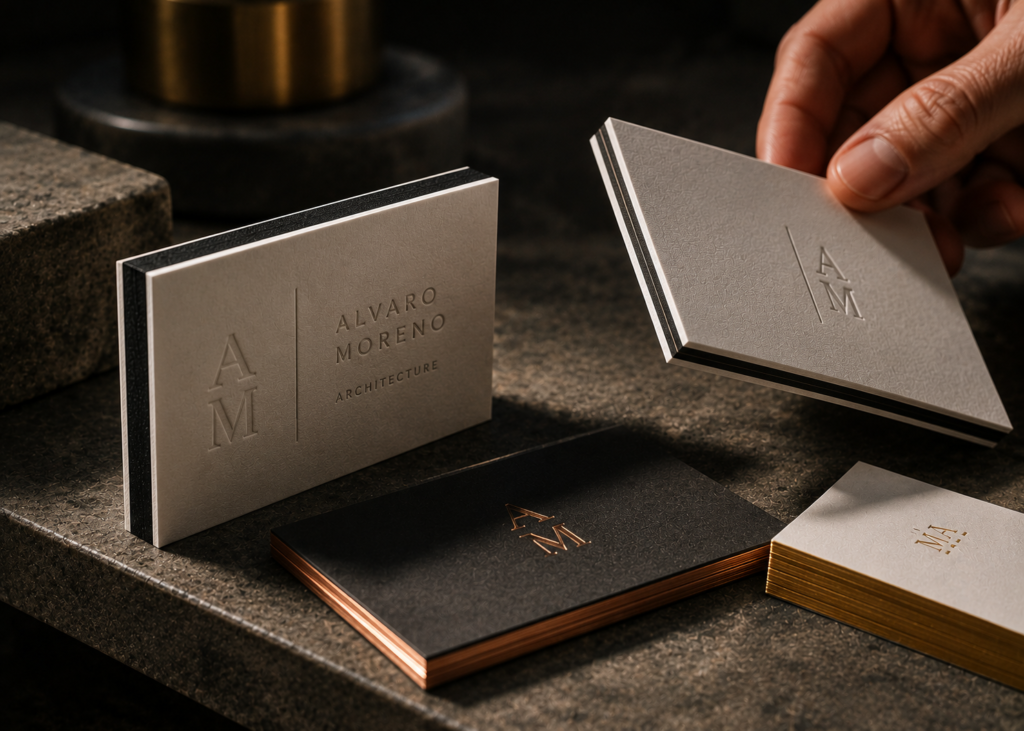
Types of Ultra-Thick Business Cards: 28 pt, 32 pt, 35 pt, 38 pt, and Beyond
Not all ultra-thick business cards look the same or are constructed in the same way. Choosing between them depends on how much emphasis you want to place on the material, what finish the design requires, and what budget is available.
28 pt: A Noticeable Upgrade Without Going to Extremes
28 pt stocks represent a high-thickness option that can be produced by bonding two 14 pt layers together. Some options are available in matte, glossy, or uncoated versions.
It is an interesting alternative when you want a card that feels significantly more substantial than a standard card without necessarily reaching the maximum thicknesses available on the market.
32 pt: One of the Strongest Options in the Premium Segment
32 pt has become a common benchmark for ultra-thick business cards. MOO, for example, uses 600 gsm and 32 pt for its Luxe line, constructed using multiple layers of Mohawk Superfine paper. VistaPrint also sells 32 pt ultra-thick business cards and describes them as approximately twice as thick as its standard stock.
It is an especially attractive option for brands that want a premium card without necessarily moving into even thicker constructions.
35 pt: More Texture and Presence
Some printers offer 35 pt stocks, including textured and uncoated surface options. Gold Image Printing, for example, describes a 35 pt option constructed using two 17.5 pt layers.
It can work particularly well when the texture of the paper is an important part of the identity.
38 pt: Maximum Physical Impact
38 pt clearly falls into the category of extremely rigid business cards. Options are available using three layers or especially thick stocks. Some providers specifically position them for premium projects, luxury brands, and pieces where physical impact is a priority.
The options can be summarized as follows:
28 pt: premium and noticeably thick.
32 pt: a balance between impact, presence, and practicality.
35 pt: greater material presence and textured options.
38 pt: maximum rigidity and a true “statement” effect.
More than 38 pt: highly specific solutions that should be evaluated according to production, use, and design.
For nyc business card services projects, it does not always make sense to choose the maximum thickness available. What matters is that the material helps communicate the brand’s positioning.
When Should You Use Ultra-Thick Business Cards?
Ultra-thick business cards make the most sense when the object itself needs to communicate something. A company competing primarily on price probably does not need to invest in a 38 pt business card. On the other hand, a firm selling high-value services may find much more value in a material capable of reinforcing its positioning.
There are several situations where this type of card can work particularly well:
- Luxury Brands and Premium Products
Perfumery, jewelry, fashion, automotive, interior design, and hospitality are categories where physical materials can complement a premium positioning strategy. A thick business card can become a tangible extension of the brand’s visual language.
- Professionals Selling High-Value Services
Architects, attorneys, consultants, real estate agents, financial advisors, and executives can benefit from a card that communicates solidity and professionalism through its material, as long as that perception is consistent with the rest of the brand identity.
- Creative Studios and Agencies
For designers, photographers, art directors, and agencies, the business card can become a small demonstration of creative judgment. A colored core, textured paper, or minimalist composition can serve as a physical representation of the design philosophy.
- Networking and Important Events
If the card will be handed out during meetings where many brands are competing for attention, standing out physically can be useful. However, the design should remain functional: the name, title, contact information, and other essential details should be easy to identify quickly.
- Complete Corporate Identity Projects
An ultra-thick business card works even better when it is part of a cohesive stationery system. Letterheads, envelopes, folders, packaging, and business cards can share typography, colors, and graphic elements to create a consistent brand experience.
In the business cards in NYC market, where different professionals and businesses compete to stand out at meetings, conferences, and business events, this type of material can be an interesting tool for reinforcing differentiation.
However, there are situations where it may be better to avoid it. If the cards need to be stored in large quantities, mailed frequently, easily placed inside very tight wallets, or kept within a limited budget, a premium 32–38 pt stock may not be the most practical solution. MOO specifically points out that thickness should be evaluated alongside factors such as budget and storage capacity.
That is why good nyc business card services should not simply ask, “What thickness do you want?” They should consider what purpose the card serves, who receives it, how it will be distributed, and what perception it should create.
Conclusion
Ultra-thick business cards can transform an everyday networking item into a tangible piece of branding. From 28 pt to 32, 35, and 38 pt, there are different levels of rigidity, construction, and texture to suit different projects. The real value does not lie in choosing the thickest card available, but in finding a coherent combination of material, design, finish, functionality, and positioning. A 32 pt card can be more effective than a 38 pt card if its texture, edge, typography, and composition better represent the brand. This is especially relevant for luxury business cards nyc projects, where every detail should feel intentional.
If you are developing a corporate identity, updating your current business cards, or looking to create a premium piece for your upcoming events and meetings, request a quote for your business card design and production project with Japan Printing. From a sophisticated card for a professional firm to a high-impact proposal for your next business cards in NYC, choosing the right paper and finish can make your stationery communicate long before the conversation begins. And if you are looking for nyc business card services capable of turning a brand idea into a physical piece, the first step is defining what you want the card to make your next client feel when it reaches their hands.