Stationery 08.02.26
Why Printed Materials Still Convert Better Than Digital Materials

Daniel Cantor
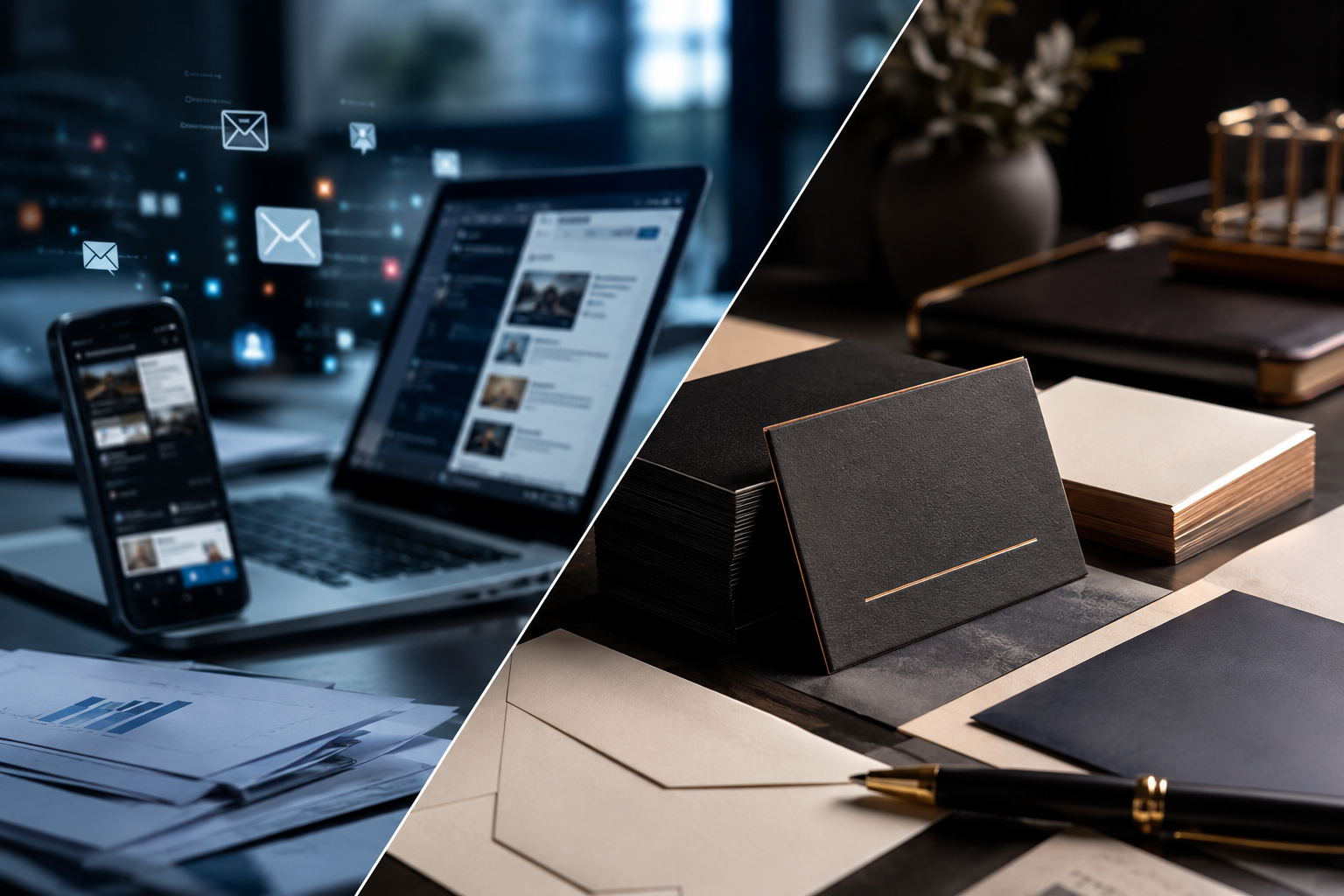
In a market where almost every brand competes for attention through ads, emails, social media, and digital content, paper may seem like a tool from the past. However, the latest data tells a very different story. In 2025 and 2026, direct mail continues to generate measurable responses, website visits, and online purchases, while research on physical advertising has found advantages in areas such as brand recall and brand association. In the first quarter of 2026, for example, JICMAIL recorded that 76% of mail was read, looked at, or reviewed, and that 9.4% of pieces prompted a visit to a website. In addition, 56% of purchases driven by mail ultimately took place online.
This does not mean that print is automatically superior to digital. It means that, when used strategically, it can occupy a space that screens are finding increasingly difficult to dominate: attention, longevity, tangibility, and perceived value. This logic is particularly relevant for businesses that need to project professionalism from the very first interaction. From a business card to a direct mail piece, good design can become a physical extension of a brand. If you are looking to develop materials that better represent your business, you can request a quote for your business card design and creation project with Japan Printing. Whether you need business cards in NYC or a complete printed identity, the goal is to create pieces that serve a commercial purpose, not simply something attractive to hand out.
Physical Attention Has Become a Scarce Resource
One of the main arguments in favor of printed materials is not that people have abandoned digital media, but precisely the opposite: they are surrounded by it. Emails, ads, notifications, posts, banners, and messages constantly compete for a few seconds of attention. In that environment, a physical object can benefit from lower channel saturation.
JICMAIL’s data for the first quarter of 2026 provides an interesting reference point. Direct mail generated an average of 4.5 interactions per piece, remained in circulation for approximately 7.8 days, and recorded 141 seconds of attention. In the case of business mail, the figures were even higher: 4.8 interactions, 9.1 days of life, and 182 seconds of attention. In addition, 76% of mail pieces were read, looked at, or reviewed.
The importance of these figures is that they show something different from a simple first impression: a physical material can remain present after the initial contact.
This can be especially valuable for:
- Sales presentations.
- Meetings with potential clients.
- Trade shows and business events.
- Packages sent to prospects.
- Corporate correspondence.
- Welcome materials.
- Brand kits.
- Business cards.
- Direct marketing campaigns.
The comparison should also be made carefully. Not every printed piece automatically produces these results, and a business card is not equivalent to a direct mail campaign. However, the evidence helps explain why the physical dimension remains commercially relevant.
A report from the USPS Office of Inspector General, developed together with Temple University’s Center for Neural Decision Making, found that physical advertisements outperformed digital advertisements on several branding-related measures, including brand name recall and brand association. Digital ads, on the other hand, were processed more quickly.
For a premium brand, that difference can be important. Speed is not always the goal. At certain moments, a company needs the customer to remember, associate, and find the brand again.
That is where a well-designed system of nyc business card services can make sense: it is not simply about placing a name, phone number, and email address on paper, but about creating a physical point of contact that extends the conversation started in person.
Print Does Not Necessarily Compete with Digital: It Can Drive Customers to It
One of the most interesting data points from 2026 contradicts a fairly widespread assumption: that when someone responds to printed material, they necessarily leave the digital environment.
In reality, the opposite often happens.
JICMAIL data shows that in Q1 2026, 9.4% of mail pieces prompted a website visit, compared with 8.7% recorded in Q1 2025. More importantly, 56% of mail-driven purchases were ultimately completed online, compared with 53% the previous year.
This makes physical material more interesting than a traditional medium: it can function as a gateway into the digital ecosystem.
A campaign can begin with:
- A carefully designed physical piece.
- A brief and relevant message.
- A QR code or specific URL.
- A landing page.
- An offer or call to action.
- A digital purchasing or contact process.
- Measurement of subsequent conversions.
In this way, paper does not need to defeat Instagram, Google, email, LinkedIn, or a website. It can encourage people to reach those channels with greater intent.
This combination is particularly useful for premium brands. A printed piece can introduce the visual identity and then direct the user to a portfolio, catalog, form, ecommerce store, or meeting calendar. The physical material creates the first contact, while the digital channel facilitates the next step.
USPS itself recommends measuring direct mail responses through mechanisms such as QR codes, phone numbers, personalized URLs, and other tracking tools.
That is why talking about luxury business cards nyc should not be limited to thinking about expensive finishes. A premium business card can strategically incorporate a QR code leading to a portfolio, booking page, professional profile, or landing page.
The right question is not “print or digital?”
It is:
What should each channel do within the customer journey?
Printed material can generate awareness and trust; a website can provide more information; a CRM can record the contact; and a sales team can close the opportunity. When the pieces are connected, printing stops being an isolated element and becomes part of a conversion system.
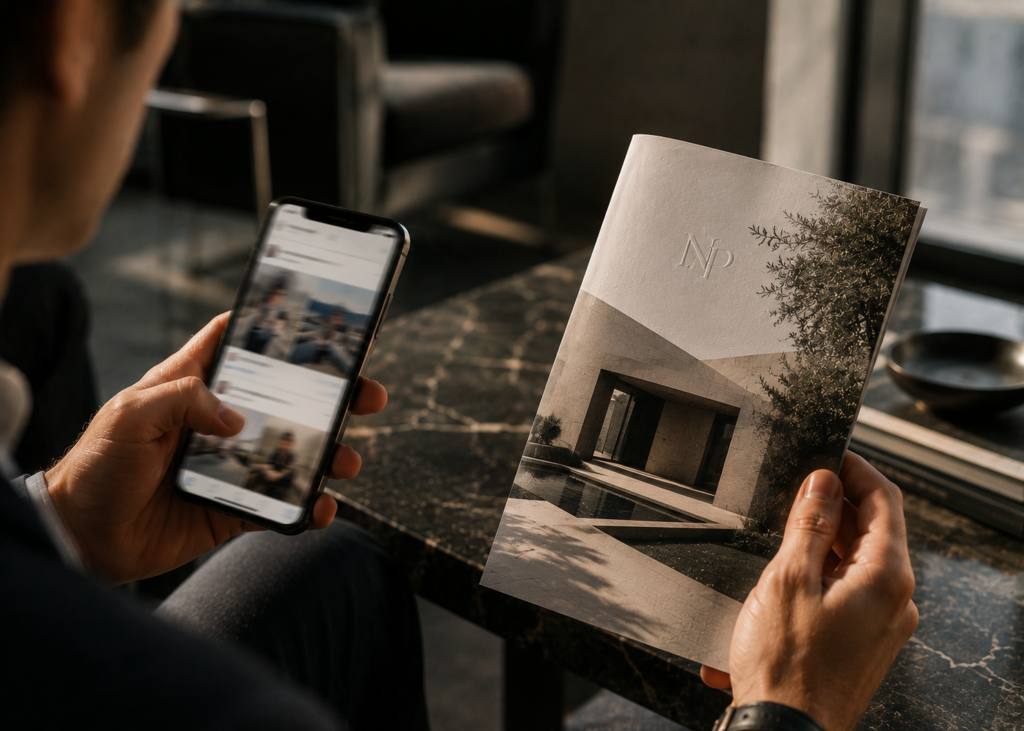
Paper Offers Something a Screen Cannot Fully Reproduce: Materiality
A screen can display an extraordinary design, but it cannot exactly reproduce the physical experience of holding an object, perceiving its weight, touching a texture, or examining a finish under different lighting conditions.
This difference is particularly relevant in premium branding.
In 2025, research on material experience and visual-tactile properties examined how the physical and aesthetic characteristics of materials affect perceptions of attractiveness. The study found significant relationships between intrinsic, aesthetic, and physical properties and the evaluation of materials.
For a business, this has a direct implication: the material communicates too.
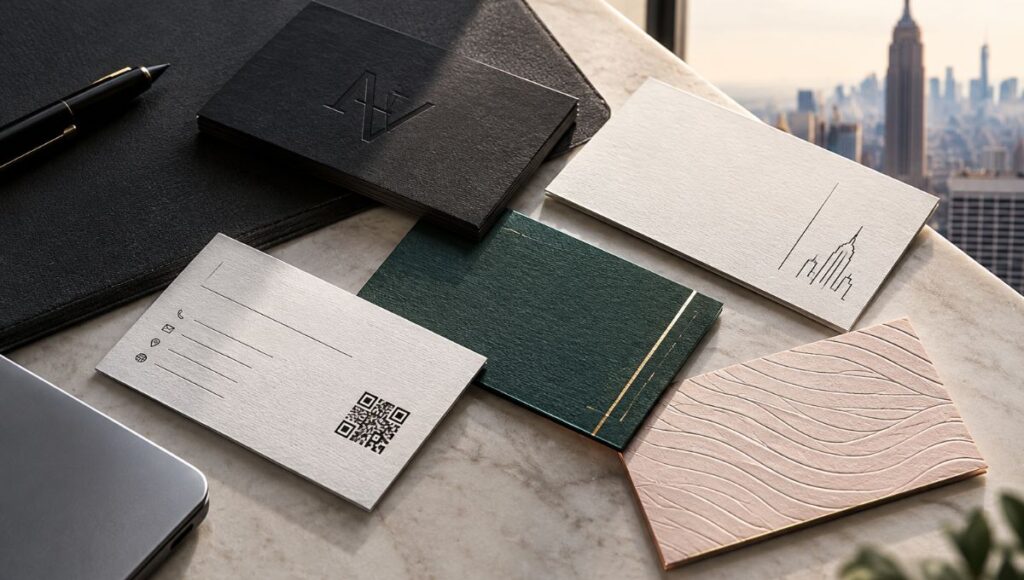
A lightweight, inexpensive paper can convey a different feeling from a heavy cardstock. A smooth surface creates a different experience from a pronounced texture. A matte finish communicates something different from a glossy element. Embossing, foil, or special details can become visual and tactile signals of positioning.
This explains why luxury business cards nyc often pay so much attention to aspects that do not appear on a screen:
Weight.
Texture.
Paper type.
Ink color and density.
Typography.
Embossing.
Foil.
Edges.
Finishes.
Proportions.
Visual identity system.
But there is an important caveat: adding finishes simply for the sake of adding them does not guarantee higher conversion. The material should be connected to the company’s identity and positioning.
A financial firm, an architecture studio, a creative agency, and a luxury brand do not necessarily need the same business card.
Materiality works best when it reinforces a brand idea.
And here, business cards have a particular advantage over many digital pieces: they are typically handed over during a human interaction. The card does not appear in isolation; it arrives alongside a conversation, a handshake, an introduction, or a meeting. The physical object can later become a reminder of that moment.
This does not mean that a physical card guarantees a sale. There is not enough evidence to claim that any printed business card converts better than a digital card in every context. What we can say is that print adds a physical dimension that exclusively digital formats do not possess.
That detail is particularly relevant for nyc business card services aimed at professionals who sell trust, expertise, and positioning even before presenting a commercial proposal.
The Real Advantage of 2025–2026 Lies in Combining Print, Design, and Measurement
The idea that a company must choose between “traditional print” and “digital marketing” is becoming increasingly unhelpful. The data from 2025–2026 points toward a much more interesting strategy: use each medium for what it does best.
Direct mail behavior in 2026 is a good demonstration. In addition to physical results, JICMAIL reported year-over-year increases in retail campaign responses among both existing audiences and prospects. In its 2025 dataset, based on nearly 5,000 campaigns, mail ROI ranged from £2.00 for certain partially addressed mail formats to £11.50 for direct mail targeted at existing customers.
These figures should not be interpreted as a universal promise of ROI for every printed piece. Performance depends on the audience, offer, design, segmentation, frequency, execution, and objective. But they do demonstrate that the physical channel can be measured as a marketing investment rather than simply a printing expense.
Measurement can incorporate:
Exclusive QR code.
Personalized URL.
Dedicated phone number.
Promotional code.
Landing page form.
CRM and lead tracking.
Attribution surveys.
Comparison between customer groups.
Tracking of generated meetings.
Sales attributed to physical campaigns.
The same philosophy can be applied to business cards.
A card can include a QR code that leads to an updated portfolio, services page, meeting booking page, or digital catalog. In this way, paper provides the physical presence while the smartphone expands the experience.
This is particularly powerful for professionals working in competitive environments such as New York. Instead of handing out a generic card, a company can use design, paper, and finishes to reinforce its positioning, while the QR code immediately connects with its digital infrastructure.
That is why luxury business cards nyc should not simply be understood as “expensive business cards.” Their true value lies in creating a coherent experience between brand, design, print, human interaction, and digital follow-up.
The same logic explains the evolution of nyc business card services: the modern service should not end when the cards leave the printing press. The goal should be to help the physical piece serve a function within a broader commercial strategy.
Conclusion
The data available from 2025–2026 does not support the idea that print is automatically better than digital marketing in every situation. What it does show is that physical material retains highly relevant capabilities: it generates attention, remains present for longer, can reinforce brand recall, and, surprisingly to some, can directly drive digital behavior. In Q1 2026, 9.4% of mail measured by JICMAIL prompted website visits, and 56% of mail-driven purchases were completed online. In other words, the future of print does not necessarily consist of replacing digital, but of integrating with it.
For businesses that want to communicate authority from the first interaction, a well-designed physical piece can become a brand asset. From business cards in NYC to luxury business cards nyc, corporate stationery, and direct mail campaigns, the goal should be to create materials that have a commercial reason to exist. If you want to transform your identity into physical pieces capable of professionally representing your brand, request a quote for your business card design and creation project with Japan Printing. With the right nyc business card services strategy, your print can be much more than ink on paper: it can become the first step toward a business relationship.